


Category Archives: 2026

Why Do We Need Medical Fosters?

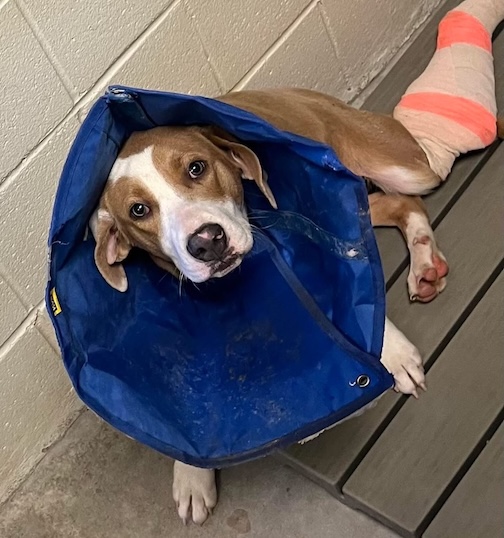
Colby came in with a fractured leg and healed so much easier in his medical foster home.

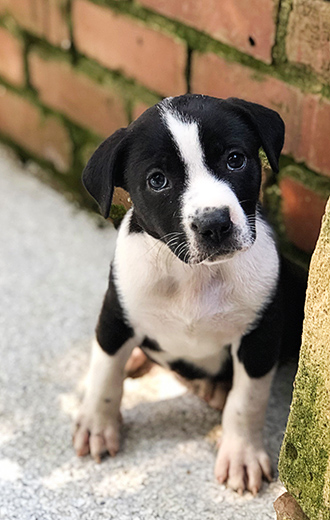
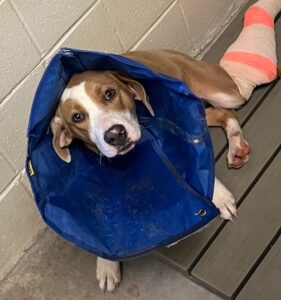
In November, the Aiken County Animal Shelter received a five-month-old puppy with a fractured leg. We named him Remi.
He was gentle, quiet, and incredibly sweet — the kind of puppy who doesn’t make a fuss.

Remi is now seven months old and still healing.
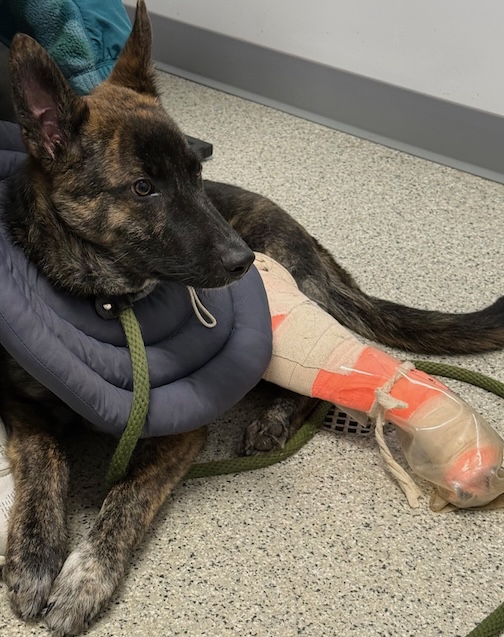
Puppy Remi came in with a fractured leg.

Our shelter takes in more than 5,000 dogs and cats every year. The kennels are always full, and our staff and volunteers work tirelessly to make sure every dog is walked and every pet is cared for. But when you’re a puppy in a splint, especially one who lies quietly in the back of a kennel, healing can take longer than it should.

Remi didn’t need anything extreme — no intensive rehab, no complicated care. He simply needed what most of us heal best with: a calm home, slow leash walks, and daily love and attention. With that kind of environment, he likely would have healed much faster.

In January, we met another stray puppy with a fractured leg. We named him Colby.
This time, we were able to place Colby in a medical foster home on weekends — and the difference was remarkable. Colby healed more quickly, regained his strength sooner, and is now adopted!
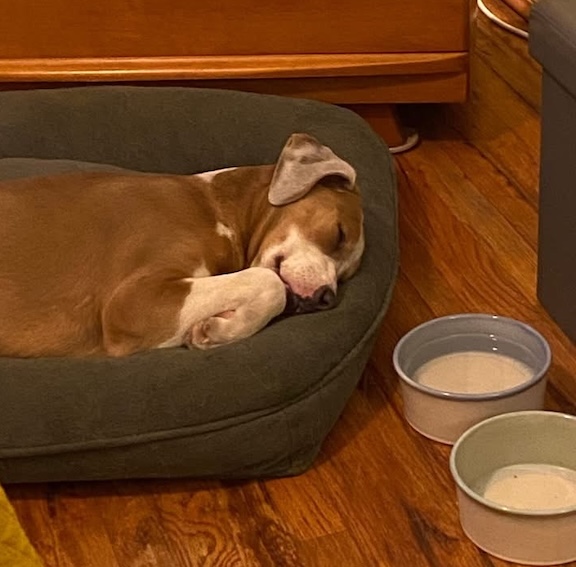
Colby was able to heal more quickly in his foster home.

That is the power of a medical foster.

Medical foster pets have curable, temporary conditions. They do not need to sit in kennels for weeks or months while their bodies heal. While our veterinary team provides excellent medical care, the best medicine is often TLC in a home.

We provide everything: medication, food, toys, and even large crates if needed. What we need are people who can offer a quiet, safe space — maybe a laundry room or kitchen where a dog bed fits, baby gates on the door, and the ability to do short leash walks while a pet recovers.

Medical foster dogs usually cannot play with other pets while healing, but many do just fine resting nearby. Colby’s foster, Marjorie, has both a dog and a cat — all quiet, respectful companions. Most days, Colby simply snoozed on his dog bed.

Dogs like Remi and Colby shouldn’t have to heal alone in a kennel.

If you can offer a calm space, patience, and love — even temporarily — you can change how a pet heals.


And sometimes, that makes all the difference.

Email FOTAS if you are interested in fostering a homeless pet, info@fotasaiken.org.

Their Lives Are In Our Hands.
By Kathy Cagle, FOTAS Programs Coordinator
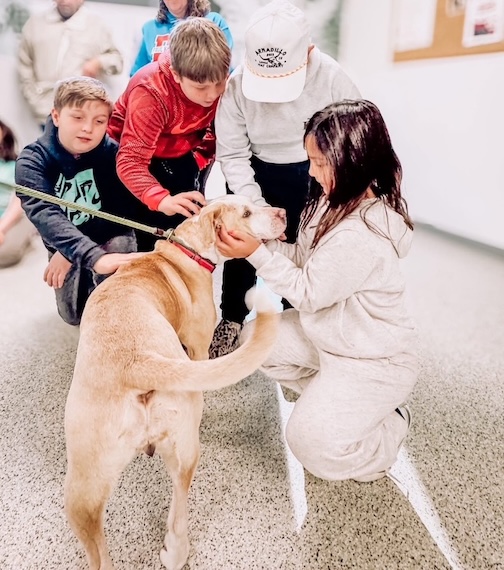
Dog Ears Reading Program: Why It Matters

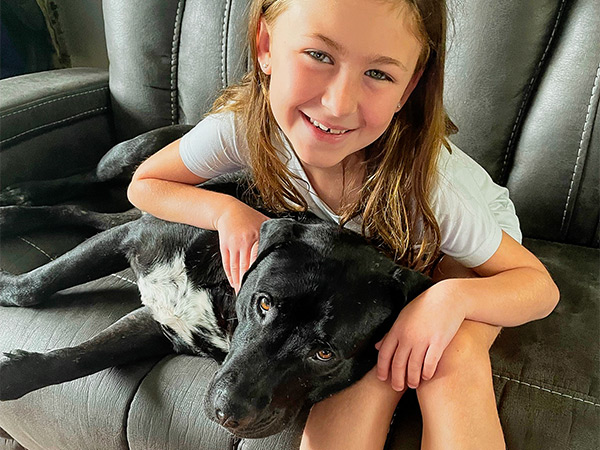
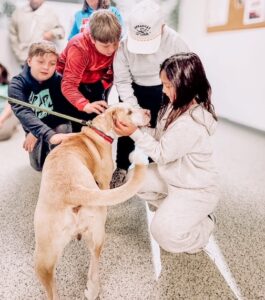
Adoptable Madeline, Hands On Time at Dog Ears

Our Dog Ears Reading Program has evolved since it first began years ago, and we are incredibly proud of how it has grown — and of the impact it continues to have on both our dogs and our young readers.

Reading out loud can be incredibly stressful for children. Many of us remember being in school, hearing a classmate mispronounce a word, and the laughter that followed. Moments like that can be very traumatic for a child.

Dog Ears creates a very different environment.

Adoptable Dante and His Young Reader

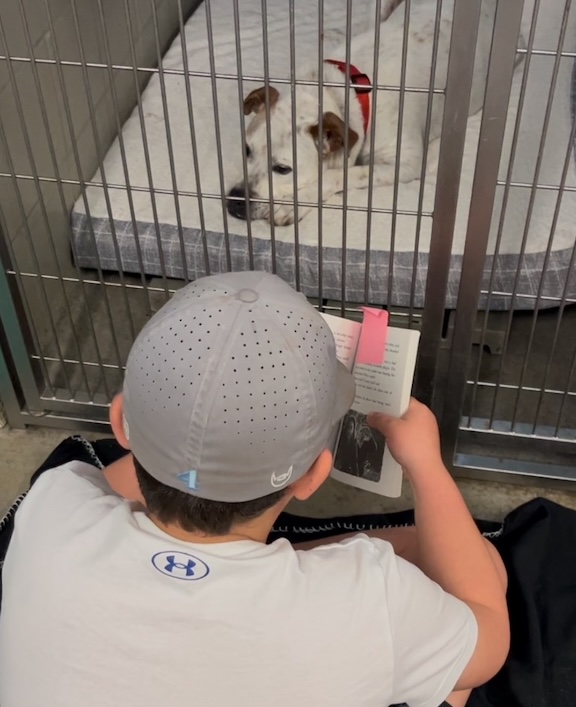
Children sit on blankets in front of kennels, reading aloud to a dog while other young readers do the same around them. No one cares if a word is mispronounced. No one minds a stutter. Parents are not in the kennels — it’s typically just 10 to 15 children and two volunteers. The pressure is minimal, and the comfort level is high.

At first, the dogs often bark with excitement when the reading begins, which can annoy the readers who are deeply focused on their books. Other children can’t concentrate at all — they’re simply mesmerized by the adorable dog in front of them (and we don’t mind that either!).

But then the magic happens.

As the reading continues, the dogs begin to relax. Many of them curl up and fall asleep, soothed by the one-on-one attention and the sound of children’s voices. It’s calming, comforting, and truly special to witness.

One group this past fall surprised us in the sweetest way. A young girl began crying because she was so worried about the dog she was reading to. She had fallen in love instantly and was overwhelmed with concern for his future. Moments like that remind us just how powerful this program is.

Is Dog Ears educational? Absolutely. It strengthens reading skills — but it also teaches compassion. These children are often reading to dogs the same size as they are, or even larger. They look into the eyes of a homeless dog and begin to wonder, why?

After reading time (we limit it to about 20 minutes — that’s about the attention span for most!), we move onto a hands-on educational session. We introduce dogs with different backgrounds: some who were neglected, some who have overcome obstacles, and others who are simply wonderful family pets.

Through Dog Ears, children learn not to judge a book by its cover — and not to judge a dog that way either. They discover just how amazing shelter pets can be. It often leads to an important question: Why buy a puppy when you can give one of these dogs a home?

At our last reading session, one little girl wanted the dog she was reading to so badly that her mom came in to meet him. Dad didn’t stand a chance. That sweet dog found his family.

We love our readers, and they love the shelter. This is how we teach children about volunteering, compassion, and making the world a better place. Maybe one will help solve the pet overpopulation problem. Maybe one will become an animal advocate. Maybe one will simply grow up to be a little kinder when they see an animal in need.

Our next Dog Ears Reading session on February 7th is already fully booked. If you are interested in reserving a spot for your young reader (ages 5–12), please email us at info@fotasaiken.org.

Their lives are in our hands.
By Kathy Cagle, FOTAS Programs Coordinator
The Poor Hound Dogs

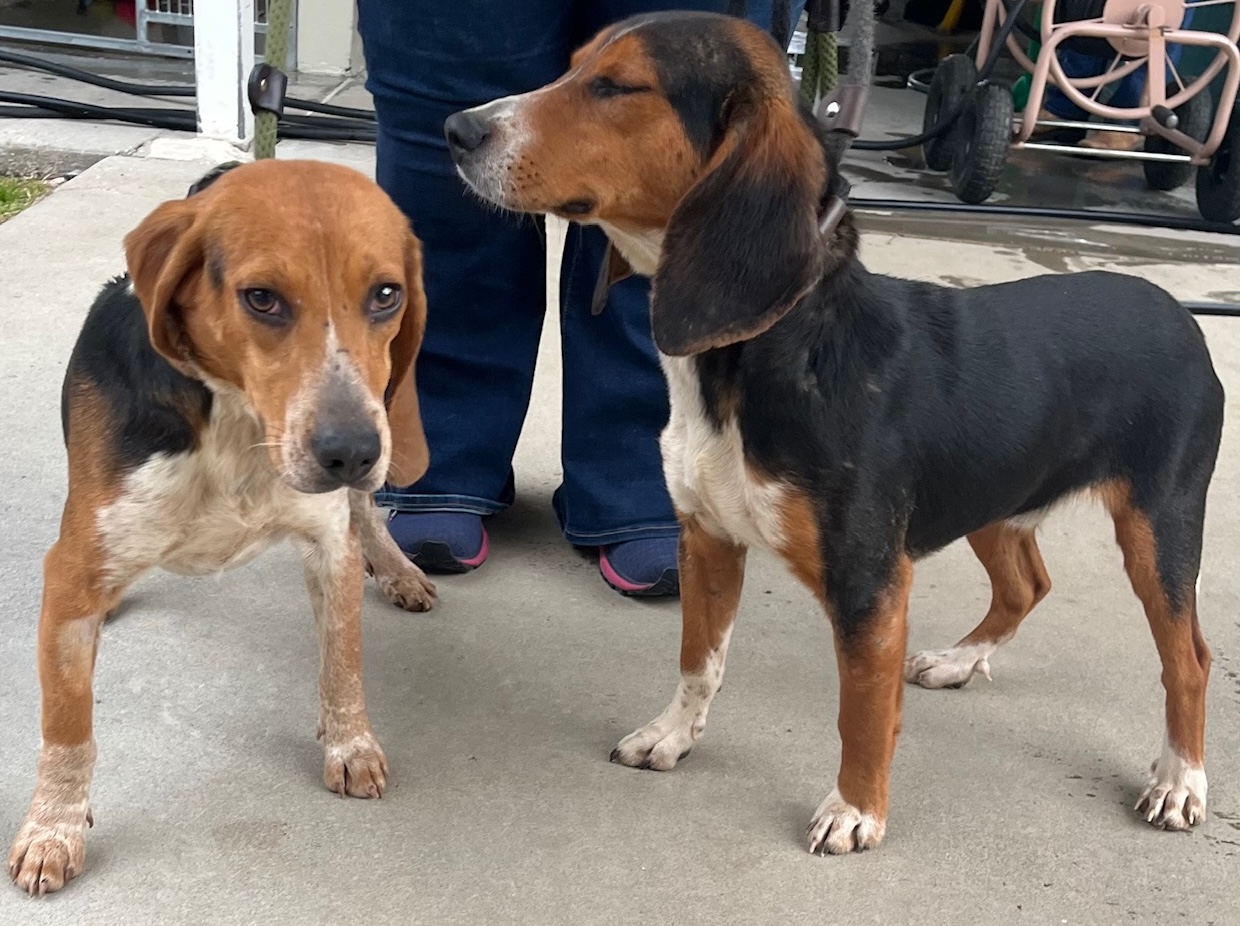
Leroy, the hound dog, is looking for someone to love.

Have you ever noticed that you never meet a grouchy hound dog?
Hounds are among the friendliest dogs you will ever know — always happy, always loving, and just as eager to befriend another dog as they are a person.

During the winter months, the Aiken County Animal Shelter sees a familiar pattern. Our kennels begin to fill with hounds — those happy howlers with long ears, soulful eyes, and wagging tails.

Sweet hounds waiting for their forever home

When hunting season ends, dogs that don’t make “good hunters” are often left behind to fend for themselves. Hounds are incredible scent dogs, bred to track deer and other animals for miles. But when they are lost or abandoned, those instincts don’t help them survive on their own. Many arrive at the shelter skinny, confused, and unsure why the people they depended on never came back.

Despite how wonderful they are, finding homes for hounds can be harder than you might think. Are they amazing dogs? Absolutely. Are they sweet, affectionate, and loyal? Without a doubt. But yes — they bark. As Aiken continues to grow and neighborhoods become more crowded, not everyone appreciates the sound of a hound’s voice.

What many people don’t realize is that hounds don’t need to live outside. Many beagles and coonhounds are just as happy curled up on the couch as they are sniffing around the backyard. With love, patience, and understanding, they make incredible family pets.

We all know that beagles are often used for animal testing because of their gentle nature and desire to please. Knowing this makes it even harder to understand how such kind, trusting dogs can be abandoned or mistreated.

Each year, the Aiken County Animal Shelter takes in more than 5,000 dogs and cats. It’s impossible not to notice the patterns — hunting dogs abandoned in the winter, furless pit bulls suffering through the summer heat. Neglect, sadly, seems to follow the seasons.

But behind every statistic is a dog waiting for someone to see them for who they truly are. And hounds? They’re just waiting to love someone again.

Their Lives Are In Our Hands.

By Kathy Cagle, FOTAS Programs Coordinator

A Win Win for Aiken County!

We were thrilled to read in the Aiken Standard the article written by County Council Chairman Gary Bunker sharing the 2026 goals for the Aiken County Council.

We thank the County Council for their great insight and initiative for including the project of the very much needed new Aiken County low cost spay/neuter clinic in the Sales Tax V Capital Projects with collections beginning in May. It is to begin being built later this year. We celebrate the Council’s goal that the personnel required for the planned clinic to be included in the 2027 budget.

We appreciate Aiken County Administrator Brian Sanders’ astute foresight and working with Council in recommending this long-term investment for Aiken County.

The building of the future low cost spay/neuter clinic is very much needed in Aiken County. Intake at the Aiken County Animal shelter is at a record high – last year the shelter’s animal intake was 5,925 dogs and cats which is 28% higher than the average intake of animals during the previous 8 years! This record high intake, with the shelter consistently being at overcapacity, puts the no-kill save rate for every adoptable animal in alarming jeopardy.

It will only get worse with the population explosion in the county resulting from so much growth and development. The intake numbers will continue to increase and the whole system will teeter on the brink of failure. After 8 years of no -kill save rates of every adoptable animal, euthanasia may once again become a necessary tool for animal control.

The best way, with proven success, to reduce the number of animals coming into the shelter is to provide low-cost spay/neutering services to the public. Sadly, there is a critical shortage of these low-cost clinic services in Aiken County.

The proof? On a per-capita basis, the Greenville County Animal Shelter’s high intake rate was identical to Aiken’s. In 2017 Greenville built their own County run low-cost spay/neuter clinic. After only six years, Greenville’s intake numbers decreased by 60% thanks to their spay/neuter clinic. Greenville County Shelter’s success story proves it is possible to reduce the Aiken County Shelter’s intake from a heart-stopping 5,925 animals per year to a manageable 2,370 animals per year.

Design plans for the future Aiken County low cost spay/neuter clinic are underway. When it is completed and running, this will be a win-win for Aiken County, its animal shelter and its unwanted homeless animal population. Their lives are in our hands.

By Jennifer Miller, FOTAS President

Pretty Boy Goes To Maine!

Gus enjoying his new life in Maine!

Pretty Boy came to the Aiken County Animal Shelter as a stray dog. He immediately won over the staff with his good looks and cuddly charm! He was calm, quiet and polite from the start.

Larger male dogs often get overlooked. Adopters worry about size, temperament and ‘marking furniture.’

This is really sad because if you ask any of the shelter staff and volunteers, the big boys are the biggest lovers! They want to please, most are housebroken and home ready!=

Pretty Boy came to us knowing commands and having the best manners. He sat for weeks with no lookers.

We posted a video of Pretty Boy on Facebook showing him sit when asked and just being his adorable self! Days later the sweetest young couple arrived from Maine! They had called the shelter asking questions about personality after being drawn to the dog in the video. They did what many won’t, they got in the car and came to save him!

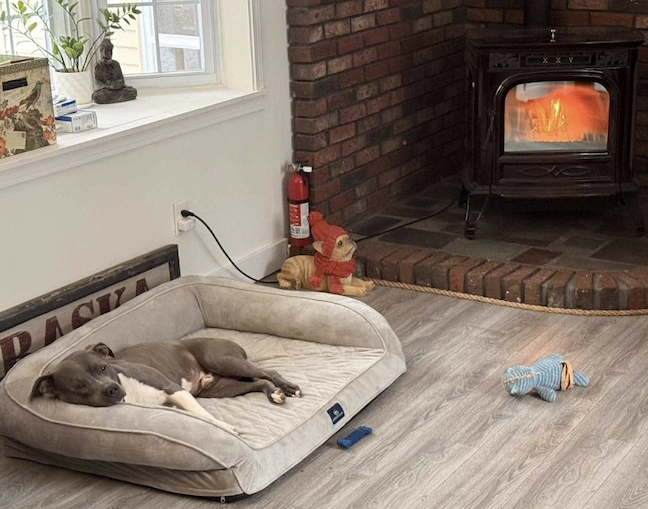
Gus enjoying his bed by the wood stove.

Rebecca has since followed up with us to share how things are going:

“Some updates on “Pretty Boy” – Now Gus
He’s settling in very well – he and Tank (dog) are aquatinted and will be integrating this week.
He’s met most of the family here and loves everyone – and they love him.
He spends most days in with mom (Bex) on his bed in front of the stove.
He’s doing very well – we couldn’t be happier.”

Everyone wants to be a hero but only some truly make the cut! We are so grateful for those that travel for a homeless dog or cat. Those that can see the innocence by watching a video and stepping up to make the trip!

Aiken County has a major pet overpopulation crisis on our hands. Knowing that people across the country want our dogs gives us hope that we can continue to save every adoptable pet! Continue to share the posts on Facebook and Instagram, FOTAS Aiken. It’s working!

Their lives are in our hands.
By Kathy Cagle, FOTAS Programs Coordinator