


Category Archives: Volunteers

The joy of fostering

07 June 2015

The joy of fostering

By Joanna Dunn Samson, FOTAS Vice President

The Igoe’s have fostered close to 100 puppies and dogs from the Aiken County Animal Shelter. The Wolcott’s and Courtney Conger have fostered well over 350. The Wisemans average about 100 per year. The Heuberger’s, our newest foster family, have already fostered 6. Ray Eckenrode fostered 12 in his first year. Sam Cato has fostered so many she quit counting.

These are just a few of our network of our committed foster families. The Igoes, Wolcott’s, Conger and the Wiseman’s specialize in taking pregnant mamma dogs and birthing their puppies or very young, motherless puppies and raising them in a nourishing environment until they are weaned. Healthy puppies are highly adoptable everywhere, but especially in the north where mutt puppies are rare because everyone spays and neuters.

Cato, Eckinrode, and the Heubergers take dogs scheduled for transfer (those not adopted locally after a period of time) out of the shelter a few days before the scheduled transfer date, allowing them time to decompress from hectic shelter life and socialize in a home environment.

In almost every case, the animals transferred to another shelter are already spoken for by the time they are loaded on the truck, or they are adopted within a week of arriving at the new rescue, which makes letting the dogs go when the time comes more bearable.

“You have to take the bigger view,” says Girl Conger. “It’s about helping as many animals as possible get out of the shelter and find a forever home, not about being a sucker for every dog you take home. It’s a simple formula: math + heart – every dog we take allows a dog crowded in the intake wing to be moved to the adoption floor. We save two lives for every one we foster.”

“Plus, it’s a never-ending supply of squishy, fluffy, adorable puppy love and puppy-breath. What could be better than that?”

They all love animals, that’s a given, but they all foster for different reasons. Eckenrode traveled for business and couldn’t adopt a dog, so fostering gave him “dog time” in small chunks. Cato does it because it’s her way of giving back to the community. Tara Heuberger does it because she wants her 5-year-old son, Tegan, to learn how to care for the dogs.

Heather Wiseman says the best thing about fostering is the time the family spends together caring for and playing with the puppies. “It’s made us a stronger family, and the puppies are so much better adjusted growing up in a home instead of the shelter.”

And they all do it different ways.  Some fosters make a safe, comfortable place for their visitor outside of the house. Others fully integrate them into their lives.

“I pick them up and bring them home, then my happy pack of 5 dogs takes over,” says Cato. “They teach the newcomer good manners and housetraining. They all sleep in the bed with me. I love it.”

Here’s the thing: we need you to foster! The dogs need you! Now! This summer! Call the FOTAS Hotline at (803) 514-4313 and we’ll tell you how.

Thank you and God Bless. Their lives are in our hands.
Then and now at the Community Aiken County Animal Shelter

31 May 2015

Then and now at the Community Aiken County Animal Shelter

By Joanna Dunn Samson, FOTAS Vice President

5000 square feet. Concrete floors with open trenches for waste removal. No air conditioning or air exchange system. No isolation facilities. No medical facilities. A tiny food prep area. No hot water. Peeling paint. Inadequate lighting. No separate cat facilities. No play yards. No volunteers. 200 anxious animals stuffed into a facility designed for 50.

It was a prescription for misery. Chance of survival at the old Aiken County Animal Shelter? About 10-15%.

Bobby Arthurs, the County’s Chief Animal Control Officer who started working with enforcement in 2001, remembers those days.

“It was hard at the old shelter,” says Arthurs, “especially in the spring and summer months when intake was so high and we’d have 3 or 4 animals crowded together in a single, small kennel. There were no volunteers or staff to walk or play with them. You’d look over the room and it was like the animals had just given up – they were all depressed.”

In those days, the shelter was overcrowded and the euthanasia rate was still 85-90% on average. A trip to the shelter was a near-certain death sentence for an animal. Often the only time an animal had any personal human contact was when they were removed from their cage to be euthanized.

All that changed when the new shelter opened last year.

“Now the shelter can separate adoptable animals from intake animals,” says Arthurs. “We have hot water, proper ventilation, sanitary medical facilities. We can isolate sick animals – that’s huge! Finally, shelter staff has the ability to improve the prospects for these animals.”

Sandy Larsen, the senior vet tech at the shelter who shares the distinction with Arthurs of having worked at the shelter the longest, agrees.

“It’s a happier, healthier place to be for everyone,” says Larsen, “staff, animals and volunteers – and as a result, our adoptions are up, our transfers are up, and our euthanasia rate is down. In fact, I can’t remember the last time we had to euthanize an animal from the adoption floor.”

I wish we could say, “It’s all better!” and rest on our laurels, but we can’t. The success over the past year is fragile and dependent on so many factors: the amount of intake, proper staffing, sufficient public funding, and volunteers. Some of those are already in question.

Our volunteer force is down dramatically because of folks leaving for the summer. One morning last week, only one person was available to walk 30 dogs.

April and May have seen record intake highs.

The County budget is strained because of reduced state and federal funding and the expenses of last year’s ice storm.

Although the Aiken community has demonstrated its support, both in commitments of time and money, to turn the shelter around, the job is not, perhaps will never be, done. Success requires resources.

Now, more than ever, we need volunteers at the shelter to walk dogs and help around the shelter. We need foster families to take animals slated for transfer out of the shelter to help alleviate overcrowding. We need all citizens to spay and neuter to reduce the overpopulation of homeless animals. We need donations to take care of special needs at the shelter.

We need you, the Aiken community, to tell your friends, your neighbors, and your elected officials how much the community shelter means to you.

And if you can, we need you to give these animals a home.

FOTAS: Transfer program and foster families save lives

27 May 2015

FOTAS: Transfer program and foster families save lives

By Joanna Dunn Samson, FOTAS Vice President.

It’s not even Memorial Day yet, and the intake wing of the Aiken County Animal Shelter is inundated with abnormally high numbers of owner surrenders, puppies, kittens and strays usually reserved for the summer months. Intake during April and May has been at record highs, far exceeding the number of animals leaving the shelter for forever homes. The shelter is forced to double or triple up animals in the kennels in the intake wing until space is available on the adoption floor. It is an agonizing state of affairs.

When this happens, FOTAS and shelter staff increase their efforts to network the animals on the adoption floor the longest (among other things) by organizing transfers to our no-kill sister agencies in other parts of the country. The transfer program has grown to include 20 partner rescue agencies over the past five years.

“It’s hard work,” says Jennifer. “The partner tells us how much space they have available, and we send them photographs and information about the dogs on the adoption floor, particularly the dogs that have been in the shelter the longest and need to be moved on. We don’t need to transfer out the small, cute dogs- they find homes quickly – we really advocate on behalf of the dogs that are hardest to place.”

In addition to the hard to place dogs, the transfer partners also take healthy, weaned puppies – a godsend during this time of year when the shelter is packed with them.   Says Miller, “Mutt puppies are hard to find and in great demand, particularly in the north, because everyone spays and neuters their animals.”

The FOTAS and County-approved foster homes are instrumental in the success of the transfer program. Once FOTAS and the transfer partner have negotiated which animals to send, FOTAS volunteers and county staff move the approved dogs to foster homes quickly, allowing the dogs a little transition time in a home before they are shipped out.

“Plus,” says Caroline Simonson, a FOTAS Director and volunteer, “moving the dogs quickly to foster frees up space on the adoption floor, allowing staff to release dogs from intake, which is so important when intake is so crowded.”

The need for foster families has never been greater. A potential foster fills out an application and demonstrates to the County that they have a safe, healthy place to care for the dogs. FOTAS is willing to pay for food and vet services to reduce the cost of fostering if necessary.

“You get to save two lives for every foster you take in,” says Toni Urben, a FOTAS foster, “ the dog you foster and the dog that takes its place on the adoption floor. My husband Gary and I love doing it.”

And so will you. Over the next couple of weeks, I’ll share with you some of the experiences of our fosters so you can see for yourself how satisfying and how necessary the job is.

We are desperate for more foster families, so if you’ve ever thought about fostering, now is the time. Please call the FOTAS Hotline at 803-514-4313, or email us at info@angelhartlinedesigns.com.

Their lives are in our hands.
Summer Heartbreak at the County Animal Shelter

17 May 2015

Summer Heartbreak at the County Shelter

By Joanna Dunn Samson, FOTAS Vice President

Summer is tough at the Aiken County Animal Shelter. While the rest of the world settles into the sleepy tempo of summer, FOTAS volunteers and County staff shift into hyper-drive to address the inevitable onslaught of puppies, kittens and owner-surrender animals that crowd the intake wing and stress county resources to alarming levels.

This year, the seasonal surge of animals started early. The shelter experienced abnormally high intake during April, and May’s numbers promise to be equally dismal.

These homeless animals will come from the County, the City, Edgefield County, occasionally private rescue agencies already filled to capacity, but primarily, they come from private citizens.  On average, the number of citizen-surrendered animals doubles during the summer months because of (are you ready?) vacations.

Vacations! It is a sad but true fact that there are people who surrender their pets to the County Shelter when they go on vacation rather than make proper arrangements for their care, consigning their confused and trusting pets to the stress of a shelter environment and a 50% chance of being euthanized. Unthinkably heartless.

Over the past year, the County and FOTAS, with the help of the community, made great strides in saving more animals and reducing the euthanasia rate, but until rampant overpopulation is checked and the horrifying intake numbers come down (a 10-year proposition under the best of circumstances, according to most experts), our goal of never having to euthanize another adoptable animal is out of reach.

In the meantime the County, with the help of FOTAS, is responsible for the care and disposition of the 4600-5000 unwanted animals that wind up in the County shelter each year. Paid for with taxpayer dollars, the County shelter has a legal obligation to accept all comers – it cannot refuse to accept an animal because there isn’t enough room. Quite frankly, it feels like sweeping back the ocean with a broom, especially during the summer months.

How can you help?

First and foremost, spay or neuter your animals, and talk your friends and family into spaying and neutering theirs. If you or they cannot afford the cost to spay/neuter, you may be eligible for County or FOTAS financial assistance.

Help us take care of the animals – volunteer at the shelter.

Become a short-term foster for dogs selected for transfer or a long-term foster for mamma dogs and their puppies until they are weaned and rehomed.

Most of all: adopt one of the deserving animals in the Adoption Wing.  For every animal you adopt or foster, you save two lives – the pet you adopted and the pet that can be moved to the adoption floor from Intake.

Make a tax-free donation to the cause at www.fotasaiken.org.

Call us at (803) 514-4313 or email us at info@angelhartlinedesigns.com and see how you can get involved. You won’t be sorry.

Take advantage of our outrageous May special: adopt an adorable “Pibble” for only $20 or a cat for $10. The adoption fees cover spay/neuter surgery, all inoculations and micro-chipping. It’s a tiny cost for taking home a new love.

Their lives are in our hands.

BY THE NUMBERS

April 2015

Total received = 481 dogs and cats

Total adopted/transferred = 170 dogs and cats

Total euthanized = 201 dogs and cats

PETS OF THE WEEK

SAUL .. American bull dog — male — 6 mos. old — 34 lbs.  — $20

ROSEANNE … Tabby — female — 2 years — 17.7 lbs  — $10

All bully dog mixes $20 and cats $10 through May 31, 2015

The County Shelter celebrates its first year anniversary

30 March 2015

The County Shelter celebrates its first year anniversary

By Joanna Dunn Samson, FOTAS Vice President

One sunny Sunday morning last year (March 2nd to be exact), Chief Animal Control Officer Bobby Arthurs and a group of FOTAS volunteers walked the adoptable dogs from the appallingly outdated old shelter to the newly constructed state-of-the-art shelter one block south on Wire Road.

It was an extraordinary scene – one long line of happy dogs pulling smiling volunteers across the lawn to their spacious new kennels. Although I knew in my head the dogs were happy because they were out on a walk and feeling our joy, in my heart I imagine they knew their prospects had just taken a major turn for the better.

They were right. The next morning, the shelter opened to the public and almost immediately Brooke, Jacob and Charlotte Jones adopted a border collie mix named Debbie and made her a part of their family. Since then, FOTAS and shelter staff have been moving animals on to new homes at record rates.

This month marks the first anniversary of the new Aiken County Animal Shelter. In the past year, 2255 shelter animals were successfully re-homed. Adoptions increased 38% from the previous year. Transfers to other no-kill shelters  (part of a network of sister agencies developed by FOTAS) increased an astounding 63%. In fact, since the new shelter opened, virtually all the animals moved to the adoption floor have found homes thanks to the dedication of FOTAS volunteers and County staff.

What’s more, the number of FOTAS volunteers has soared to over 225 civic-minded citizens because the open, cheerful public areas and the landscaped, fenced-in play yards (another FOTAS contribution) make time spent at the shelter a pleasure. FOTAS volunteers worked an estimated 14,000 hours last year (the equivalent of 7 full-time positions) and have become indispensable partners with County staff.

In addition, FOTAS has invested $150,000 over the past year for the continuing needs of the new shelter, ranging from large ticket items like a new FOTAS van for transfers and off-site events to more routine items such as leashes, collars and grooming supplies.

Finally, FOTAS has invested $35,000 in eliminating the source of many of the problems at the County shelter – overpopulation of unwanted pets. To date, FOTAS has fixed nearly 950 citizen-owned pets and community cats.

By any measure, this first year at the new shelter has been a success, perhaps evidenced most notably by this fact: in the past year, the euthanasia rate dropped from 71% to 54%. In the past two months, the euthanasia rate dropped in January to a monthly record low of 25% and in February to 35%. Now, that’s progress.

There is still so much to do. Intake numbers are still disturbingly high, especially in the summer months. High intake means more volunteer manpower is needed to compliment the efforts of County staff. We need to continue to supplement the County’s financial resources to properly care for all these animals.

The sustained generosity and commitment of the Aiken community is essential for FOTAS to continue this important work. Together we made a difference in the past year, and together we will soldier on in the future to achieve our mission – to never euthanize another adoptable animal. Their lives are truly in our hands.

Thank you and God bless for your enduring and profound kindness.

PETS OF THE WEEK

BURKHARD — Male, German Shepherd, 4 years old, 74 lbs — $70

SCOOBY — Male, Domestic Medium Hair, 3 years old, 8.2 lbs. — $35

FOTAS volunteers — ambassadors of the Aiken County Shelter

15 March 2015

FOTAS volunteers -- ambassadors of the Aiken County Shelter

By Joanna Dunn Samson, FOTAS Vice President

It’s Wednesday at the Aiken County Animal Shelter. The lunch break is over, and the doors have been opened to the public for the afternoon. There are a few moments of peace and quiet before the inevitable wave of shelter activity rolls in like gangbusters.

A man brings the bed, collars, leashes, toys, food and food bowls of his beloved, recently deceased dog to the shelter as a donation. A woman stops by to check about a lost Chihuahua. The phone rings. Another woman and her daughter have returned to adopt Mira, a sweet lab cross. Adoption Coordinator Annette van der Walt fills out the adoption paperwork and arranges for Mira to be micro-chipped. A young man fills out the forms for a spay/neuter voucher and asks to see some puppies. The phone rings again. A woman stops by to look at a German shepherd newly released to the adoption floor. A family drops off 10 boxes of dog biscuits as a donation. A FOTAS Board member drops by to discuss a potential fundraiser with Shelter Manager Martha Chadwick. A man walks into the lobby with a cat in a crate to be surrendered to the shelter. The phone continues to ring.

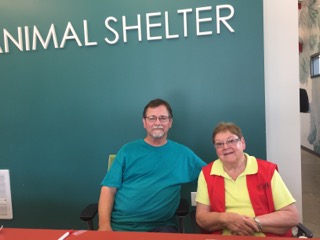
In the middle of it all – the staff, the customers, the phones, the dogs, the cats – Pat Ludwig and Paul Tallent, the FOTAS volunteers on desk duty, take it all in stride with a smile and an offer to help everyone who walks through the door. They are unflappable.

“We do a little of everything,” says Pat, who has been manning the front desk on Wednesday afternoons with Paul for about a year. “We answer phones, take folks back to the adoption area, help Annette with paperwork if she’s backed up, answer questions. All it takes is a little patience and a willingness to listen.”

“Plus,” says Paul with an easy smile and a twinkle in his eye, “a sense of humor always helps.”

Paul and Pat are two of a group of committed FOTAS volunteers who work the desk in the front lobby.  According to Annette van der Walt, the front desk volunteers play a crucial role.

“They are on the front lines – the first face the public encounters when they walk through the door. Their demeanor and presentation sets the tone in the lobby during those busy times,” says Annette, “so good people skills are a must.”

FOTAS volunteers Pat and Paul enjoy their time at the shelter. “I like being busy,” says Paul, “and I enjoy working with staff and other volunteers and especially with the people who come to the shelter looking to adopt. Nothing makes me happier than to see a happy person taking some lucky animal home to be loved and cherished.”

Pat agrees. “To see an animal and a person bond right in front of our eyes and go home full of hope and excitement, now that’s special. It always makes my day.”

FOTAS needs more volunteers to serve as ambassadors of the shelter. If you have ever considered helping us with this important work, now is the time. Call us at (803) 514-4313 or email us at info@angelhartlinedesigns.com. You’ll be glad you did.

Their lives are in our hands.

BY THE NUMBERS

February 2015

Total received=279 dogs and cats

Total adopted/transferred-=235 dogs and cats

Total euthanized 102 dogs and cats

Eutho rate-=37% lowest record to date for a normal February! Yay for the new shelter facility and staff

PETS OF THE WEEK

SYDNEY      Male, Beagle — 2 yrs old — 39 lbs — $70.00

BLUE     Male, Domestic Short Hair — 1 yr old — 7 lbs —  $35.00

FOTAS and the SPCA-Albrecht Center come together for Fences4Fido

08 March 2015

FOTAS & SPCA-Albrecht Center come together for Fence4Fido

By Joanna Dunn Samson, FOTAS Vice President

When the SPCA-Albrecht Center’s Development Director, Chrissey Miller, proposed a joint FOTAS/SPCA pilot to save dogs from the cruel existence of living their entire life at the end of a chain tethered to a stake, we were delighted. Not only was it a chance to make a joint statement about responsible dog ownership with our sister agency, it was an opportunity to join a growing national movement to eliminate the cruel practice of chaining a dog to a stationary object.

Thus Fences4Fido was born. The team picked a date – February 28th – and began the search for a family in Aiken or Aiken County who wanted to improve the life of their tethered dog with a more humane containment system that was beyond their means to acquire without assistance. In short order, FOTAS volunteer Connie Jeffcoat identified the perfect family:  long-time Wagener residents with 4 mixed bull-breed dogs chained to stakes in the backyard.

“This family was a great choice,” said the County’s Chief Animal Control Officer, Bobby Arthurs. “They loved their dogs, but had fallen on some hard times and just did not have the resources to provide fencing. They were grateful for the help.”

The family also presented a challenge because they had 4 dogs in the backyard: 2 that don’t get along and 1 escape artist, so containing all 4 dogs in one fenced-in area wasn’t going to work. The team chewed it over and came up with an alternate plan: 2 fenced-in areas and one long trolley with plenty of unobstructed space to run for the escape artist. Plus, each dog would get a brand new doghouse.

All the pieces came together last Saturday for the first Fences4Fido project, and the results were sensational – on all levels.

First of all, the family was friendly, receptive and accommodating. I was worried they might feel overwhelmed when this team of 20 strangers showed up and began digging in their back yard, but they didn’t. On the contrary, they tended to their dogs, chatted with volunteers and offered to help. It was a pleasure to meet and work with them.

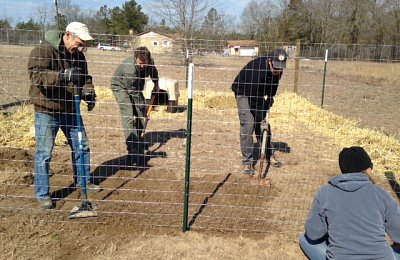
Second, the team of FOTAS and SPCA staff and volunteers, joined by Bobby Arthurs and Assistant County Administrators Andy Merriman and Brian Sanders wielding shovels and post-hole diggers, was awesome. Everyone was relaxed and efficient, and by lunchtime, the work was done.

“I felt a kindred spirit and enthusiasm among all of us who donated their time and skills to complete the project on time and under budget,” said Jennifer Miller, President of FOTAS.

“Plus,” said Frank Townsend, FOTAS Treasurer, “it was fun. The teamwork was impressive and at the end of the day, the pups were happy.”

Yes they were, which brings me to the most significant result of all – the reaction of the family’s 4 sweet, lovable dogs. They were visibly and undeniably happy. The 3 dogs romped around their assigned pens, elated with their newly found freedom. The escape artist explored every new inch of his greater movement on the trolley with a light cable and better fitting collar, wagging his tail furiously.

Every single one of us who witnessed their joy was deeply moved. Our efforts have made an enduring difference in the lives of these dogs.

After all, isn’t that what it’s all about?

PETS OF THE WEEK

HOPE      Female, Lab mix — 1 yr old — 86 lbs — $70.00

SYLVESTER     Male, Domestic Short Hair — 2 yrs old — 9 lbs —  $35.00

Lenny’s Brigade strikes again

25 January 2015

Lenny's Brigade strikes again

By Joanna Dunn Samson, Vice President of FOTAS

Shortly after sunrise last Saturday, 3 trucks set off from Wagener and Graniteville with a collective cargo of 19 feral cats trapped the night before from various cat colonies located in and around the two towns. The cats, trapped by volunteers of FOTAS’ Trap, Neuter and Release (TNR) program called Lenny’s Brigade, were on their way to Aiken Animal Hospital to be spayed or neutered by Drs. Cindy Brown and Mary Tricia White, two local veterinarians with big hearts and a deep commitment to animal welfare.

By 8 a.m., all 19 crates had been unloaded at the Hospital.  By 8:15, Drs. Brown and White, accompanied by Veterinary Technicians, Leanna Long and Paxy Holley, and Veterinary Assistant Megan Degan, began to sedate and prep the animals for surgery. By noon, all 19 surgeries had been completed, and the cats were resting comfortably in their crates.

“Dr. Brown and her team are amazing,” says Jennifer Miller, President of FOTAS. “They are top-notch doctors dedicated to the highest standards of professional care. When Dr. Brown offered to donate not only her time, but her clinic and supplies as well, we were speechless with gratitude.”

“Between our practice and our families, time is a valuable commodity for all of us,” says Dr. Brown, “so we made the decision as a team to take this on. We have the skills, we have the place, and we have the supplies, and we thought, ‘This is really important.’ It’s another way for us to give back to the community.”

It is important. Community, or feral, cats are domestic cats that have been either abandoned or born in the wild. Highly adaptable, cats can survive quite well on their own; however, an unmanaged, unchecked population of feral cats has the potential to upset the balance of nature in the area in which they live.

Not surprising since it is estimated that a female cat is capable of producing as many as 100 kittens during her lifetime.  If a typical colony is 25 cats, and slightly more than half are female, that’s 1300 offspring per colony without factoring in the breeding capacity of the males and the fertility of the subsequent generations of female offspring.

TNR programs like Lenny’s Brigade involve humanely trapping, sterilizing and inoculating community cats, then returning them to their original colony. Long-term studies indicate that over time, TNR is a more effective way of reducing community cat populations than just euthanizing them since new cats always move in to fill the void.

Lenny’s Brigade, the brainchild of FOTAS volunteer Dr. Kathy Bissell, DVM, pioneered TNR in Aiken County, and thanks to FOTAS organizers Colleen Timmerman, Vicky Wright, Dottie Gantt, Carol Miller and other volunteers, and Mayor Mike Miller from Wagener, FOTAS has organized and funded the spay/neuter of more community cats in the past two years than any other organization in the County – 409 feral cats to be exact.

Back at the Aiken Animal Hospital, after a couple of hours of rest, the 19 cats were loaded back on to the trucks and returned to Wagener and Graniteville, where they were collected by the FOTAS volunteers who had dropped them off in the morning. Most of the cats spent the night with the volunteers and were reunited the next morning with their colony of origin – safe, inoculated from disease and no longer capable of contributing to future generations of unwanted cats.

If you do the math, that’s at least 1300 less future homeless kittens to worry about thanks to 2-3 days of hard work by dedicated volunteers.

It’s a start.


PETS OF THE WEEK

CASPER — Male, American bulldog  mix — 4 1/2 months, 23 lbs — $70

PINE — Male, Domestic Short Hair — 3 months — $35

New Year’s resolutions worth keeping

11 January 2015

New Year’s resolutions worth keeping

By Joanna Dunn Samson, FOTAS Director

Every New Year’s Eve since I turned 40, I have resolved to launch a rigorous exercise program in the upcoming year. Now that I am 60, it doesn’t seem like such a lofty goal as much as a practical necessity, but somehow the commitment wanes as January turns into February turns into March turns into . . . well, you get the picture.

I am not alone –“ exercising more” is a common New Year’s resolution, so why is it also the one so quickly abandoned with such minimal guilt? I’m no psychologist, but I’m going to hazard a guess here: resolutions that involve tending only to the physical body are perhaps too shallow to be taken seriously.

What if, then, we were to resolve to exercise in a way that satisfies both body and soul, makes homeless animals happy and saves lives at the same time?  Based on the experience of our FOTAS volunteers, those resolutions might just be winners.

Susan Hilderbrand began volunteering at the old Aiken County Animal Shelter in 2008, the year before FOTAS was founded. At first she played and walked with the animals. Now, twice a week, Susan takes pictures of the shelter residents, talks to volunteers and staff about their personalities, gathers some data such as age, weight, gender, and uploads this information to PetFinder, a national database for animal adoptions, and to the County shelter’s website.

“I love taking those photos,” says Susan. “I can help find these animals a forever home by expanding the potential pool of adopters, which is so satisfying. Some of my friends say, ‘How can you go there two times a week, every week, and see all those poor animals?’ And I say, ‘How can I not?

She continues. “Plus, the new shelter is such a bright and welcoming place, it’s a pleasure to spend time there with the animals, the other volunteers and the County staff, who are just plain wonderful.”

Kathy Jacobs and her 9-year-old son Noah have been walking and playing with the shelter dogs since last May.

“It’s something I always wanted to do,” says Kathy, “but I wasn’t sure I could. I was afraid I’d be too upset seeing all those homeless dogs. I was wrong. It’s so easy to make them happy and so rewarding when they finally go home with that special someone.

I spend a lot of time hugging the dogs. These animals have been abandoned or abused or alone for so long, I feel like it’s my and Noah’s job to teach them how to be loved.”

In addition, this year Noah performed odd jobs around the house between Thanksgiving and Christmas and donated the money to FOTAS. Talk about dedication.

Karen Peck began volunteering for FOTAS at the County shelter 4 years ago as part of a Walk a Hound, Lose a Pound Program. Since then, in addition to walking the dogs, she baths, grooms, takes photos of the animals for FOTAS social media and assists with transfers. Karen injured her leg last year, so now she works the front desk, greets visitors, helps with adoption counseling, and performs the thankless job of filling out paperwork for adoptions and transfers.

Karen and her family have also fostered over 50 dogs in the last 18 months. “I love fostering,” she says, “We get to care for and love them for a short time knowing they’re already spoken for. It’s magic.”

So there you have it. These FOTAS volunteers and their colleagues in the FOTAS volunteer army, exercise their bodies, exercise their hearts, exercise their humanity, and exercise their civic duty, and in the process, saved the lives of hundreds of the County’s most vulnerable animals.

Proof positive that resolutions involving a commitment of body and soul are the most enduring.

Make your resolutions count this year; join us in this important work. Their lives are in our hands.


BY THE NUMBERS

162 dogs and cats adopted during the “No Place Like Home” adoption special Nov. 29, 2014 – Jan. 3, 2015


PETS OF THE WEEK

DARYL     Male, Shepherd mix, 9 months old, 44 lbs — $70

PIPPA   Female, Domestic short hair, 1 1/2 years old — $35

FOTAS community: making a difference for homeless animals

21 December 2014

FOTAS Community: making a difference for homeless animals

By Joanna D. Samson, FOTAS Director

What makes the Aiken County Animal Shelter a true community shelter?

It’s not just because it’s owned and operated by a public body and funded through taxpayer dollars. It’s not just because it’s obligated by law to serve all of Aiken County, which is 50 times larger than the City of Aiken (1071 square miles versus 21) and serves a population almost 5 times larger than the City’s.  It’s also not just because the County shelter is legally obligated to accept and care for all County strays, all County and City owner-surrenders – a whopping average intake of 400 dogs and cats per month.

Those are the legal technicalities that define the basic nature of the County shelter, but to me, it is a community shelter because the Aiken community itself has claimed the County shelter as its own. It is the heart that makes the shelter tick, the force that breathes life into the daunting task of caring for thousands of homeless and abandoned animals every year.

That’s why the Friends of the Aiken County Animal Shelter (FOTAS) was created in 2009 – to marshal the private resources of the Aiken community to supplement and support the County shelter’s limited budgetary and operational needs.

FOTAS formed an army of committed community volunteers, who perform the jobs equivalent of 9-10 paid staff positions. Volunteers organize, coordinate and implement transfers to no-kill sister agencies in other parts of the country, on-site events such as Woofstock, the Dog Ears Reading Program, puppy socials and off-site adoption events. They recruit and support local citizens to privately foster animals in their homes.FOTAS volunteers developed and manage a website and social media to keep the community informed. They create and run fundraising community events like Play Fore the Dogs, Broadway Sings for the Pets, and the FOTAS Hunter Pace. They coordinate spay/neuter services through FOTAS Fix-a-Pet and Lenny’s Brigade. They love-up the cats and walk the dogs at the shelter 6 days a week and on holidays. They work with and train difficult-to-place dogs. They write thank-you notes, make phone calls, keep the books and greet visitors at the shelter.Because FOTAS is an all-volunteer organization funded solely by private donations, virtually every dollar contributed to FOTAS is used to improve the lives of and outcomes for the County’s homeless animals.

In addition to funding improvements to the shelter itself (play yards with appropriate drainage and irrigation, a separate feline facility with a hot water heater, stainless steel kennels with guillotine doors, surgical equipment, etc.), FOTAS dollars also fund essential needs (heartworm medicine, flea and tick treatments, toys, leashes, collars, supplies for foster families, vet clinics for pets and citizens in need, an off-site adoption van and the like) and the programmatic costs of transfer and spay/neuter.

Here’s the good news: all this effort and support is making a difference.

In the last 23 months, FOTAS organized and funded the spay/neuter surgeries of 859 dogs and cats and transferred 1339 dogs to sister agencies. As of the end of November, there has been a 14% reduction in shelter intake and a 43% increase in adoptions and transfers over 2013. The average monthly euthanasia rate has dropped from 90+% in pre-FOTAS years to 55%. That’s huge.

This Christmas, make your holiday gifts count: donate to FOTAS to save a life in honor of your family and friends. A $45 gift will fix a pet cat and $80 a dog. A $75 gift will treat a heartworm positive dog. A $90 gift will help FOTAS fund the transfer of an animal to a no-kill facility and a forever home.

Seriously, does Dad really need a new tie? Call us at 803-514-4313 or email us at info@angelhartlinedesigns.com to discuss the possibilities.

And don’t forget to take advantage of our special Holiday adoption rates until January 3rd ($35 for dogs and $10 for cats).

Merry Christmas, Happy Holidays and God Bless you and your family.

BY THE NUMBERS

January 2013 through November 2014:

1339 dogs/cats— FOTAS worked with the Shelter and transferred these animals to partner rescues/shelters ( this is in ADDITION to local adoptions from the County Shelter )

876 pets & community cats were spayed/neutered, organized and paid for by FOTAS ( this is in ADDITION to those animals spayed/neutered through the County’s voucher program )