
Tag Archives: FIV positive felines

Simba: Unforgettable Tabby Cries for Hugs from Shelter Staff

Last year, 4,000 animals arrived at the Aiken County Animal Shelter (ACAS) and it can be overwhelming to remember them as they are adopted to new homes or reunited with their owners. But there are certain pets in need that are such loving, charming characters, they steal your heart and become etched in your mind forever.

Simba, a chubby-cheeked orange Tabby who is currently available for adoption, fits in this special category.
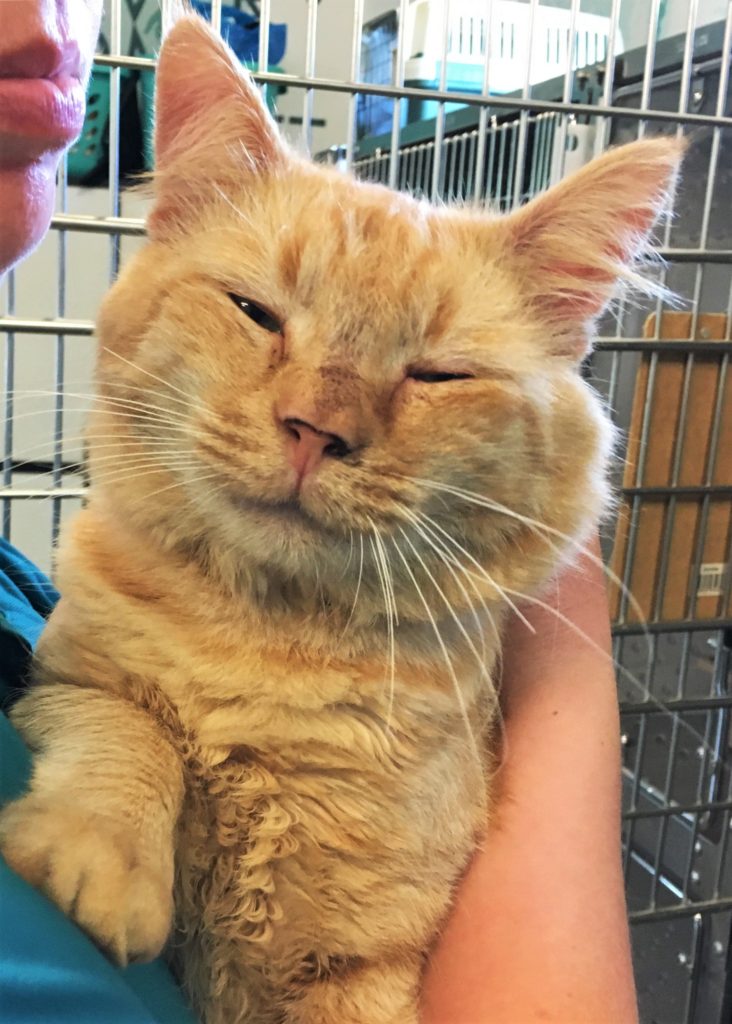
Simba, an FIV+ orange Tabby, loves getting attention from the Shelter staff and volunteers, and they love hugging him.

Besides being cute and charismatic, Simba acts more like a dog than a cat. He often cries when people walk through the shelter lobby, past his cat condo. Eventually, a staff member or volunteer will open his kennel door to give him some attention. After 30 seconds of getting petted, Simba puts his paws on their right shoulder and climbs into their arms. Simba has a low meow that sounds like a grunt and when he’s happy, he purrs and meows repeatedly. Then his eyes become half-closed and he gently bumps his face into their chin to show his appreciation.

Most everyone is a bit affected by COVID-19 anxiety these days, and the shelter staff is no exception. So throughout the day, employees stop by Simba’s cat condo to say hello or pick him up for a warm hug. A quick cuddle with fluffy, 10-pound Simba is a real stress reducer.

Super Simba arrived at the shelter about three weeks ago. His owner surrendered the 3-year-old kitty because he didn’t get along with her other cats. Simba doesn’t like to share his humans.

After the medical staff treated, examined and tested Simba, they discovered he has Feline Immunodeficiency Virus or FIV. FIV infection is transmitted primarily by deep bite wounds. It is not transmitted sexually or through casual contact with another cat.
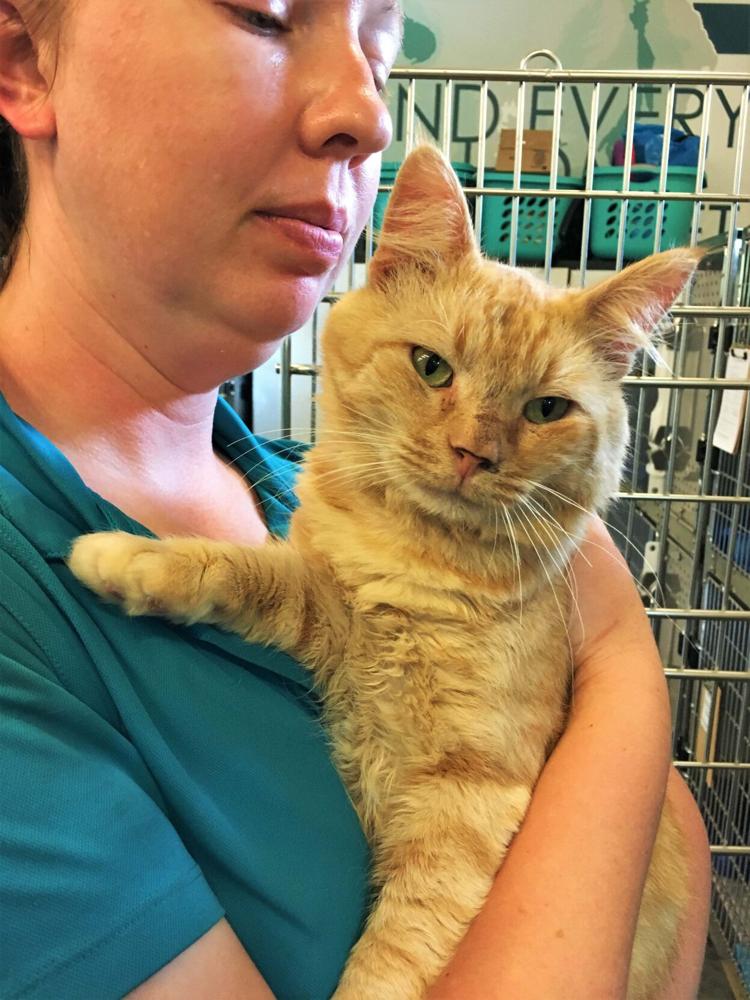
Simba will be missed and remembered by the staff and volunteers long after he’s adopted.

Infected cats like Simba can live a completely normal and long life. However, there’s a chance he may at some point succumb to the feline virus, which attacks the immune system and allows him to become vulnerable to other infections. Also, FIV positive cats should be kept indoors to prevent them from being exposed to other diseases. Simba will be a perfect indoor-only cat since he loves the luxuries of life and being with his humans.

Simba is a special cat. He’s one of those rare homeless pets that we will miss and remember long after he’s adopted. But he desperately needs a loving home where he can be the only cat and start living life away from the shelter. He needs a family of his own.

If you would like to adopt Simba, please make an appointment to see him by calling the ACAS at (803) 642-1537, option #5, or email to info@fotasaiken.com.

In the meantime, the volunteers and staff will take turns giving him hugs.

Their lives are in our hands.


— By Bob Gordon, FOTAS Communications Director
Feline FIV is a Virus, Not a Death Sentence

Each day as I finish my rounds at the shelter, I leave a list of things to be done for our team of veterinary assistants (three of the hardest workers on the planet!) that includes testing our newest cat residents for Feline Leukemia (FeLV) and Feline Immunodeficiency Virus (FIV).  When I come in the next morning, my heart would sink if they told me that anyone tested positive for either disease.  This had always meant euthanasia since these cats were considered unadoptable.  But over the last several years, that opinion has changed.

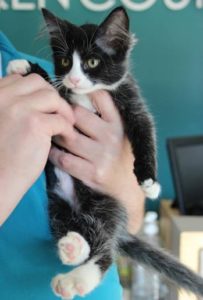
Becky was the first FIV positive kitten adopted under the Shelter’s new FIV adoption program.

FIV infection is transmitted primarily by bite wounds.  It is not transmitted sexually or through casual contact.  Infected cats may live a completely normal and long life. Or they may at some point succumb to the virus, which attacks the immune system and allows the cat to become vulnerable to other infections such as respiratory, mouth, bladder, skin, and eye infections.  Once the cat develops recurring infections, the disease is inevitably fatal. What allows some cats to live with the virus and develop no symptoms and some cats to become ill is unknown and therefore unpredictable.

Kittens may test positive if born to an FIV positive mother but that is most likely due to transfer of antibodies and most of these kittens will test negative within six months.  True FIV infections in kittens are possible but not common.  Because of this, the Aiken County Animal Shelter has decided to adopt out FIV positive kittens.  We will retest these kittens in six months at no charge.  The adopter must understand that we can in no way guarantee these kittens will test negative, although statistics show that most kittens will become negative.

In the case of adult cats, things are a little trickier.  We have no way to predict the outcome for these cats.  We recently adopted out our first two FIV positive cats, Rowan and Martin.  They were adopted by someone who already has an FIV positive cat, so they posed no threat to spread the virus – an ideal placement.  Any home with no other cats would also be a great option.

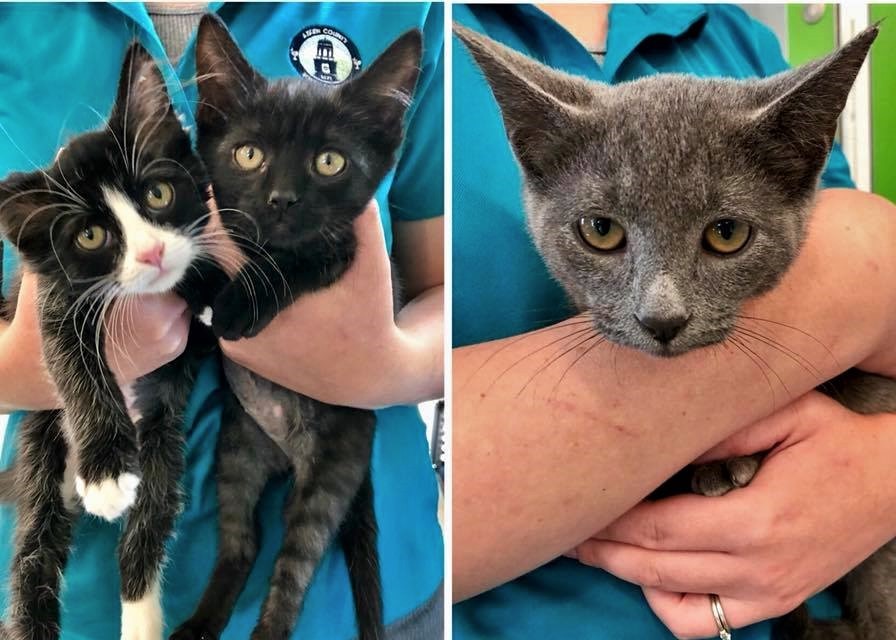
Adoptable FIV positive kittens are now available at the County Shelter for just $10 each, including (left to right): Becky, Analeese and Tillie.

We are often asked if this infection is contagious to people or dogs, and the simple answer is no.  But if any member of the family is immunocompromised or on immunosuppressant drugs, to be safe we don’t recommend exposure to these cats.

All FIV positive cats should be kept indoors to prevent the cat from being exposed to other diseases.  They should also be kept inside to prevent the possibility of exposing other neighborhood cats to the infection through “cat fights” as we know cats are fiercely territorial.

I know that we are asking a lot of someone to adopt a cat that may have a shorter than normal life span.  But the way I look at it is that God made the majority of “pet species” with shorter life spans than ours.  So, we will inevitably experience the heartbreak when we lose them after 10-15 years.  These cats develop FIV through no fault of their own, but just by acting in the true nature of a cat.  Does this mean they shouldn’t experience a loving home for the time they do have on this earth? 

We always end this column with the words, “Their lives are in our hands,” and never has this been more true.  If you are selfless enough to consider adopting one of these cats, please let us know so we can contact you the next time we see that dreaded positive result on a test.

— By Dr. Lisa Levy, Aiken County Animal Shelter Veterinarian