


Blog

News & stories

Blog

News & stories

Keep up with all things FOTAS! Meet adoptable pets, hear from volunteers, and stay informed about events taking place in your community.

Why you should spay or neuter your pet

By Joanna D. Samson, Vice President, FOTAS

Last year, 4800 animals passed through the door of the Aiken County Animal Shelter. 3000 of those animals were saved. 1800 did not leave the Shelter alive.

The vast majority of these animals did nothing wrong. They were victims of owners who brought them into this world and then washed their hands of them, leaving the rest of us to pay for their neglect.

And while 3000 is a record number of animals saved thanks to the efforts of the County and FOTAS, make no mistake: it is impossible to re-home all 4800 animals in a pet-saturated community like Aiken or in the communities served by our rescue partners in other parts of the country.

The only way to reduce the shockingly high number of animals consigned to the Shelter is for every Aiken County pet owner to spay and neuter their pets.

Plus, it’s good for your pet. In addition to lowering intake at the Shelter, your pet will live longer. Spayed or neutered animals have significantly less health problems.

Spayed or neutered animals also are less likely to roam, which means they are less likely to catch diseases from other animals, get lost, fight with other dogs, or get hit by a car (it has been estimated that 85% of dogs hit by cars are unaltered).

Spaying your female before she is 6 months of age means you can avoid the messy, noisy heat cycles that typically occur twice a year and that wreak havoc among the neighborhood’s male canine and feline populations.

Your cat or dog will be a better pet – spaying and neutering eliminates unpleasant spraying and marking.

Neutering your dog decreases potentially aggressive behavior to other animals and people – particularly children, who are by far the most frequent victims of dog bites.

Plus, it’s cheaper for the community as a whole. If everyone fixes their pets, it will dramatically reduce the number of homeless and abandoned animals that must be cared for with taxpayer’s dollars in the public shelter system.

By the way, if you are worried that spaying or neutering your dog will make him less protective, don’t be. Dogs are naturally protective by nature, particularly if you love and feed them.

Nor will altering you pet make it fat and lazy – only a bad diet and lack of exercise will do that.

Moreover, the cost to spay or neuter your pet has never been more affordable. Aiken County has a voucher program, supplemented by FOTAS, to provide low-cost spay/neuter services to residents who need financial assistance. The vouchers are distributed at the County Shelter at 333 Wire Road.

Make arrangements to spay or neuter your animal today. Convince your neighbors, friends and family to spay and neuter their pets, too.

There are so many loving, deserving animals in the Shelter that need a home – why bring more animals into a world where their safety and care is so uncertain?

Their lives are in our hands.
Free Training Session Included with Every ACAS Dog Adoption

By Bob Gordon, FOTAS Communications Director

Susi Cohen comes with every dog adoption at the Aiken County Animal Shelter (ACAS). Or, rather, her expertise and guidance does. As the shelter’s expert dog trainer, she provides a free, private session for everyone who gives an ACAS dog or puppy a forever home.

“When dogs leave from the shelter to their new residence, it is a big, happy change but also can cause stress,” Susi explained. “The dogs find themselves in a different environment, and will often rely on their new owners to direct them. That’s when I come into the picture.”

In addition to receiving the training session, adopters are provided with Susi’s contact information so they can call and check in with her if they have questions or need additional training advice.

Susi is the president of the Palmetto Dog Club in Aiken and has worked with and trained animals for more than 30 years. She volunteers at the shelter, helping other volunteers and County staff with basic dog training skills and working one-on-one with dogs that need special attention.
In most cases, the training serves to show the adopters standard disciplinary techniques such as teaching their dog how to: heel and walk well on a leash; stop jumping up on people and furniture; sit on command; or follow proper housebreaking procedures. But sometimes Susi takes on and solves more severe behavioral issues such as a Pit Bull mix that chased and scared an adopter’s horses; a chocolate Lab that liked to chew on his adopter’s car interior; and a Terrier that kept relieving herself in the house immediately after being walked outside.
But even such rare and extreme cases are usually resolved relatively fast. Susi said it all comes down to motivating the dog by using continuous, positive reinforcement and building that bond with your animal.

“The biggest mistake people make is being inconsistent,” Susi said. “They do one thing for a day or two, and then try something different, and then go back to the first approach – and the dog gets confused. The dog has to be able to connect the dots.  The key to training success is constant repetition with positive reward”, she explained.

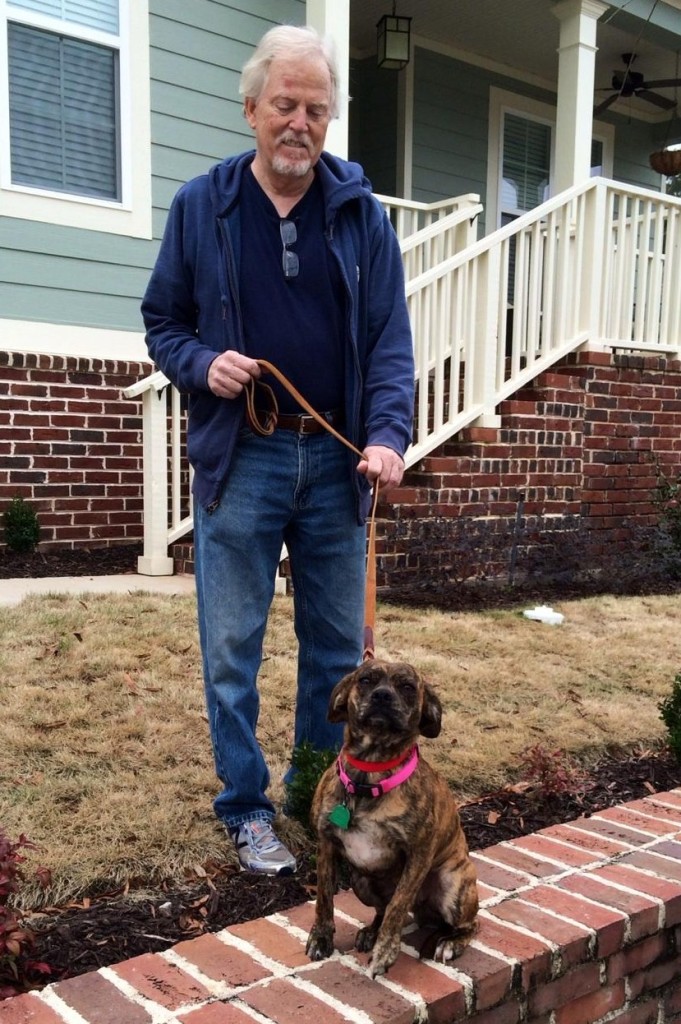
One adopter who recently learned this important lesson is Jim Brownlow of Aiken. He adopted Ruthie, a one-year-old brindle Hound mix, in December and took the free training session with Susi to improve his new dog’s manners.
Ruthie is so friendly, she wants to jump up on people. She also sometimes suddenly stops during her walks because she gets distracted. But Susi showed Jim how to give the appropriate commands for getting Ruthie to follow some simple procedures. Extremely pleased with the session, Jim plans to take more instruction from Susi.
“The training really helped me because I was doing some little things wrong out of habit, and Susi got me on the right track,” he said.
Thanks to such success stories, an increasing amount of people are taking the free training and the shelter’s rate of adoption returns, already low, is dropping.

“When dogs behave well at their new adopted home, it means they become part of the family,” Susi said.

Their lives are in our hands.

In the Yard

By Joanna D. Samson, FOTAS Vice President

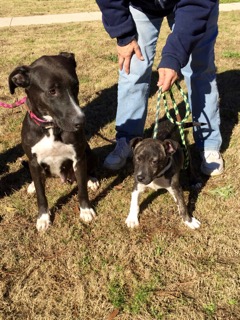
On a recent morning in the yard of the Aiken County Animal Shelter, a sweet, quiet dog named Alexa was basking in the sunshine when a dark brindle puppy named Terry scrambled to her side, volunteer in tow.

Alexa gave the puppy a friendly sniff. “Hey, little guy, you new here?”

“I am,” wheezed Terry, straining against his leash. “It’s all so confusing. I had a sister and we were on the side of a road and I don’t remember how we got there and then this man stopped and put us in a truck and brought us here.” Pant. Pant.

“And we were so scared and then we were in some room with other dogs and we got had to get shots and Oh! I hate shots and then we had to get a bath and Oh! I hate baths, too.” Pant. Pant.

“And then some lady took my sister and I had to sleep by myself and if that ain’t bad enough, I heard some volunteer say: ‘Every dog must get sprayed and tutored before they leave!’” Having worked himself into a frenzy, Terry rolled on his back and wailed, “I hate getting sprayed and I’m too young to be tutored!”

Alexa licked Terry gently on the ear. “Whoa, little man, slow down! I know it’s scary, but it’s going to be okay, I promise. That nice Kathy Jacobs, FOTAS’ new part-time staff person and program coordinator, will check on you every day. You get two meals a day and a warm place to sleep. That’s a big deal for me. I used to sleep in the dirt under a leaky porch.”

Terry stopped gnawing on his leash and cocked his head. “Hmmm … yeah, the food …”

“Plus, every day the FOTAS volunteers come and take us for a walk. They rub my tummy and scratch behind my ears – I’m talking world-class ear-scratching here. Sometimes they throw me a ball and sometimes we just hang out by the bench, watching the world go by. When we go back inside, we get a toy and a treat. Then it’s naptime. It’s a good place to wait for our forever family.”

Terry attacked a leaf fluttering across the yard, ripped it to shreds and spit out the pieces. “Family? What’s a family?”

Alexa wagged her tail. “A family is nice humans who take you to their home and love you forever. With your cute white leg and one blue eye, you’ll find a home in no time.”

She sighed, dropped to the ground, and laid her head on her paws, a little sad. “Me? Well, I’m a little older and kind of saggy. I’m also heartworm positive, but Dr. Levy says I’m not sick, and I’m being treated, and I shouldn’t give up hope.”

Terry eyed his volunteer’s shoelaces and sized up the odds of catching that one floppy piece on the first try. One should never give up hope, he thought, and pounced.

Alexa and Terry are ready for their forever homes. Alexa is 3 years-old, spayed, and very well-mannered. Terry is a neutered (not tutored) 10 week-old, happy, frisky puppy.

Please don’t wait. Their lives are in our hands.

Pulling for the Pibbles

By Joanna Dunn Samson, FOTAS Vice President


Luci was surrendered to the Aiken County Animal Shelter by her owner, who had been deployed overseas.

Olivia was picked up by Aiken County Animal Control, starving and anxious.

Harley spent the first part of his young life outdoors, starving and dodging abuse from the drug-addicts who claimed to own him.

Dante was found wandering the County roads in search of food. He was malnourished anxious and mistrustful.

Ginger spent her entire 2 years of life at the end of a chain. She has permanent scars on her neck and head from her chain and is heartworm positive (HW+).

All of these unfortunate animals are what we call “Pibbles” – pitbulls or pitbull mixes. Open admissions shelters across the country are inundated with Pibbles. It’s a real crisis. They are the hardest dogs to place, spend the longest resident time in the shelter, thus straining limited resources and space. Pibbles are euthanized in greater numbers than their less muscular, less energetic and less square-headed brethren.

Yet Pibbles make extraordinary pets and companions. Today, Luci and Olivia are companions to veterans and working on their service dog certifications. Harley has been adopted by a local, loving family. Dante is living the good life on a farm in Maine. Our dear Ginger, a little scruffy and scarred up, found her true love at an off-site adoption event at Stable View and spends her days loving and being loved.

Here is what you need to know about the Pibbles in the County Shelter.

Because it takes so long to find them homes, Shelter staff and FOTAS volunteers have had lots of time to observe and assess these dogs, so we’re confident they have the right temperament to make great pets. Our volunteers work with the Pibbles daily to channel their naturally energetic instincts and make them more adoptable – no small chore since 90% of them have never had basic obedience training or a regular routine of feeding and exercise.

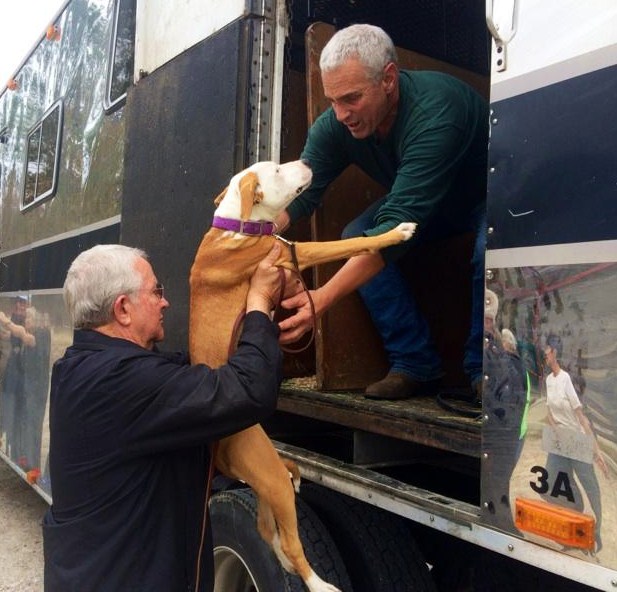
Moreover, we work with our foster families and our no-kill rescue partners to find homes for these dogs when they are not locally adopted. We don’t need to transfer the cute, fluffy dogs that happen to come our way – they find homes in a heartbeat. We choose dogs for transfers that have been on the adoption floor the longest, which are, more often than not, our Pibbles.

For those dogs that aren’t selected for transfer or can’t be transferred out of state because they are HW+, FOTAS reaches out to its rescue partners to find them homes. If they need to be treated for heartworms, FOTAS funds the first six months of treatment (via the established slow-kill method).

It breaks my heart to see so many of these noble, big-hearted animals lined up in the kennels at the Shelter, desperate for someone to give them some attention, a little love, and a home of their own.

Dogs like handsome Bryon, who wags his tail so hard, it bleeds; or Rob Roy, a gentleman pit with the heart of a lamb; or little Tiger, who is wild about children and loves to play and kiss.

Please don’t wait. These dogs have done nothing to deserve their fate. They need our help.

Their lives are in our hands.

Labor of love, Part 3: You can make a difference

By Joanna D. Samson, FOTAS Vice President

Here’s what I know about you: you have a big heart and you love animals (or you wouldn’t be reading this article). You probably have pets at home – maybe a dog or cat or two or more – and those pets bring you and your family great joy and lots of laughs. You are sickened that almost 5000 abandoned and abused animals pass through the Aiken County Animal Shelter each year, and you wonder: how can this happen in this community you love and call home?

And although you are relieved that a record number of shelter animals were saved last year (almost 3000) thanks to the combined efforts of FOTAS, the County and the community, you are profoundly saddened that another 1900 had to be euthanized, either because they were irreparably damaged emotionally and/or physically by the cruelty or neglect of other humans or because we just couldn’t find them homes fast enough.

You want to do something that matters, but what?

Here are some ideas to think about.

  • You can volunteer at the shelter, where you can work with the animals or help at the desk. You can commit to any amount of time that makes sense in your life – there is no amount too small. You can maybe set aside Tuesday afternoon? Great. Only have an hour on Thursday morning? Also great. The FOTAS volunteer program is structured on blocks of time committed by people like you – just tell us what you would like to do and how much time you can reliably commit. We’ll make it happen.
  • You can foster dogs for a short period of time that have been approved for transfer to a sister no-kill agency in other parts of the country, which allows the dogs to decompress from the stress of shelter life beforehand and creates much needed space on the adoption floor for a dogpat with evie tues dec 29th from intake. Or, you can foster mama dogs and/or their puppies until they are old enough to be transferred or adopted. All you need is a safe, protected place in your home or your garage or barn to house the animals. FOTAS even pays for food and medical supplies, if necessary.
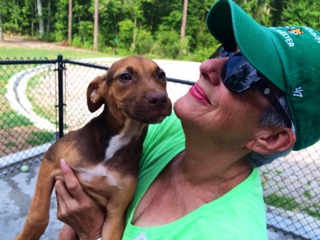
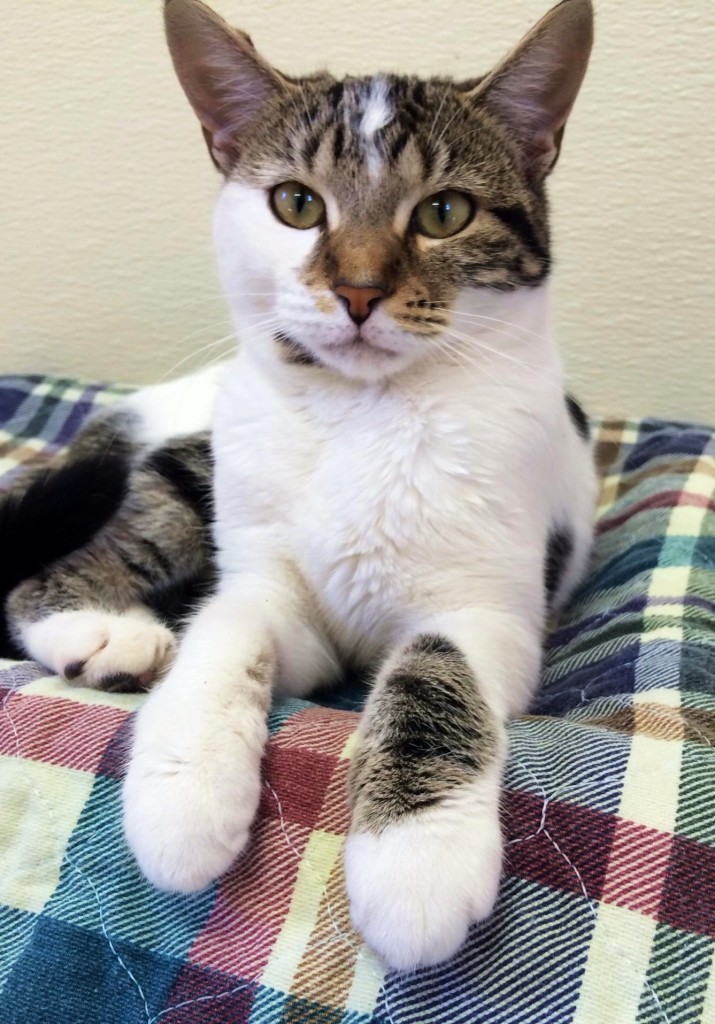
  • You can adopt your next pet from the County Shelter. That’s huge. Unlike other private no-kill shelters, the County Shelter does not have the luxury, space or resources to hold their animals for a long time: it is an open admissions shelter, required by law to take all animals. At the no-kill shelter, the animals can stay until someone comes to adopt them. At the County shelter, the animals are  at risk unless they can be transferred or adopted out quickly.
  • Or you can donate to FOTAS. We will use that money to improve the quality of life for the animals at the shelter, pay the costs associated with transfer, or attack the problem at its source through the FOTAS Fix-a-Pet program or its Lenny’s Brigade for community cats.

Contact us today at volunteer@aiken.org or at (803) 514-4313. Your help makes the difference between life and death for these unfortunate animals.

God Bless and Happy New Year.

Strictly a labor of love, part 2: Volunteering at the shelter

By Joanna Dunn Samson, Vice President of FOTAS

Caroline Simonson and Sandra Proctor walk dogs at the Aiken County Animal Shelter four times a week, as does Ellie Joos, who works with the shelter’s energetic “pibbles” and organizes FOTAS on-site programs. Karen DeCamp walks dogs every Tuesday. Jerri Wesner and Rita Tregnor walk dogs every Saturday morning. Peggy Babineau does it all: walks dogs, mans the desk and fosters dogs pending transfer. Pat Gilbert, Richard Proctor, Bill Joos, Agnes Bye, Kari and Holly Heiens, Jerri Smith, Wally and Susie Huiett, Ellen Fox, Lanni Brancato, Judy Thompson and Nanci Santos all commit their time to make certain the dogs on the adoption floor experience a little human love and attention at least once a day.

Then there are the devoted folks who man the shelter’s front desk, greet visitors and provide much needed assistance to hard-working and over-worked shelter staff: Kate Bailey, Cathy Palma, Linda Taylor, Neil Welks, Pat Hundertmark, Joyce Egge, Pat Ludwig, Paul Tallent, Bob Purdy, Melanie Oldham, Pricilla Denehy, Richard and Linda Leitner, Belinda Ebert, and Joan Locke. The day-to-day shelter work would not get done without their steadfast commitment.

These are only a few of the many FOTAS volunteers at the shelter that made it possible to save approximately 2950 animals this year: that’s more than 164% increase from 2011 and 10 times more animals saved than in the pre-FOTAS years. These volunteers are responsible and accountable. The volunteers perform duties at the shelter that are performed in private organizations by paid staff: on-site programs, off-site adoptions, fundraisers, special events, public relations, community outreach for spay/neuter programs, animal socialization, and managing the crucial foster and transfer programs, to name a few. The volunteers are the heart and soul of FOTAS.

Why do these volunteers commit themselves day after day, week after week, to a public open admissions shelter where the number of homeless animals exceeds the number that can be adopted locally or transferred to no-kill shelter partners in other parts of the country? Where public resources are strained? Where euthanasia is a profoundly sad fact of life until the day that all animals are fixed and intake numbers come down?

Our volunteers know they make a real and measurable difference in the lives of, and the outcomes for, the County’s homeless animals. It would be easy to get discouraged, but they don’t. They take the long view: they focus on the animals we save, and hands down, FOTAS and the shelter save more animals than any other organization in the County.

But above all, our FOTAS volunteers are caring, generous people who express extraordinary acts of kindness, and scientists now know what the great spiritual masters have known for centuries: that acts of kindness promote happiness and a sense of well-being.

Exercise your kindness muscles this year. Save lives and boost your happiness quotient in the process. Join FOTAS to fight the good fight until every adoptable animal finds a home. Contact us at 803-514-4313 or at volunteer@angelhartlinedesigns.com.

God bless and Happy New Year.

Their lives are in our hands.

Strictly a labor of love

By Joanna Dunn Samson, FOTAS Vice President

Volunteering at an open admissions shelter is strictly a labor of love, particularly in a place like Aiken County where intake runs consistently between 4500 – 5000 animals every year. No one with a heart can witness the endless procession of abandoned cats and dogs without being profoundly affected.

Most of these animals have never been to a veterinarian. They have never been inoculated from preventable killer diseases like distemper, rabies or parvo. Most have spent their life outdoors, in many cases with no shelter from the elements, and in worst cases tethered to a chain their entire life. They are crawling with fleas and often riddled with parasitic worms, particularly heartworms, which are deadly left untreated. The majority are malnourished and underweight, their ribs protruding through a lifeless coat and skin rubbed raw from scratching at fleas or mange mites.

Virtually all of them are unsprayed or unneutered, left to breed indiscriminately. Females with health issues produce more sickly, unwanted puppies – many of which die from lack of basic care, or worse, from being tossed out of a moving car like a crumpled paper bag.

You think I am exaggerating? Sadly, I am not. By the time most of these animals make it to the shelter, they are sick and scared and anxious and justifiably wary of humans. Many are irreparably damaged – physically, emotionally or both – by neglect and abuse. In those cases, the best thing we can do is to end their misery by humane euthanasia.

As for the rest of them, Shelter staff and volunteers do what they can with the limited resources and time available. The animals are bathed, inoculated and treated for fleas and worms. They are sheltered from the elements and fed twice a day. When they are moved from intake to the adoption floor as limited space becomes available, they are fussed over by staff and volunteers. The dogs are walked and taught basic obedience skills to make them more adoptable. Without question, the care is basic and institutional – there are far too many animals to give them the same level of attention they would get in a responsible home – but in most cases, it’s the best care they’ve ever had.

This year we expect to save +/- 2950 animals. It’s not perfect, but compare that with the days before FOTAS and the new Shelter when annual intake reached a high as 6000+ animals and only 300 were saved. Thanks to the commitment of the County and FOTAS, that’s thousands of more animals saved in the past 5-6 years.

As for the other roughly 1900 animals that won’t make it out of the shelter this year – it’s tragically unfair and outrage is the proper response, but direct your outrage appropriately: at the people who won’t spay and neuter their animals, who allow their animals to breed indiscriminately, who never provided their animals with proper medical care, and who would just as soon dump their sick, unwanted animals on the taxpayers to clean up their mess rather than do the right thing.

In the meantime, do something positive to help the County and FOTAS save more animals. Volunteer your time. Foster. Donate money and supplies. And please, please adopt from the County Shelter and bless those animals with a life of love free from hunger and fear.

Without you, they are lost. Their lives are in our hands.

Merry Christmas and God Bless.

Business Community Rallies for County’s Homeless Animals

By Edie Hubler, FOTAS Director
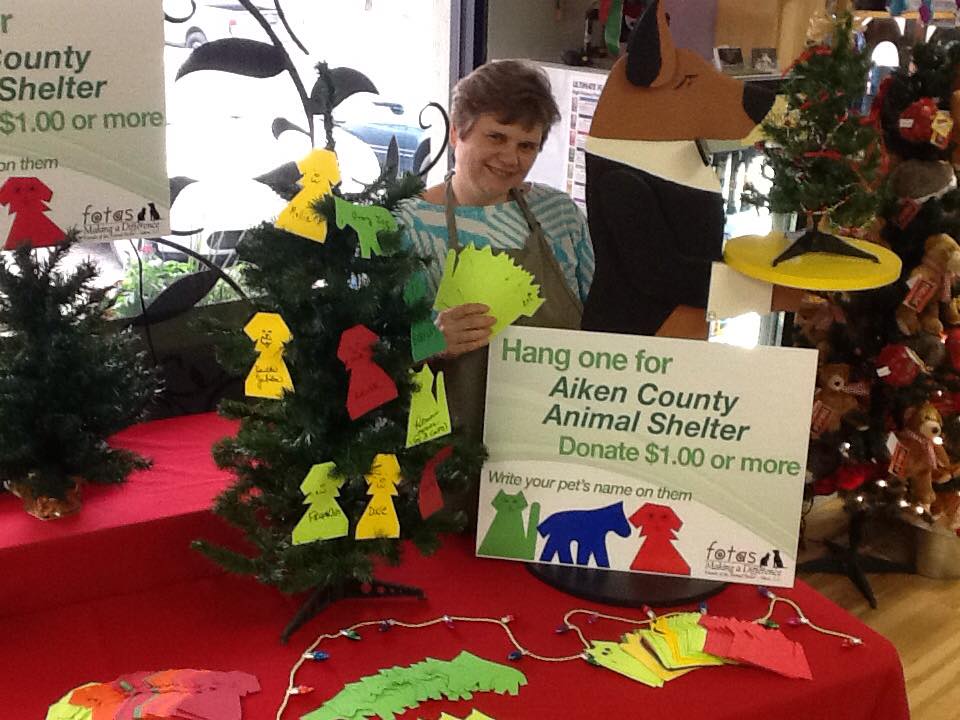
As Jeri Barrett, owner of Herbal Solutions, remembers it, a little brown and white hound dog named Mae was the spark that inspired “Hang One for the Animal Shelter”.

Jeri was an exhibitor at the 2014 FOTAS Woofstock event at the Aiken County Animal Shelter. Jeri wasn’t looking for a dog, but Mae, one of the adoptable dogs, caught her eye. At home that night, all she could think about was the hopeful Mae sitting quietly in her kennel. Jeri called the shelter on Monday and learned, to her great relief and delight, that Mae had found a home.

Although Jeri was already a veteran supporter of FOTAS, Mae touched her heart in a big way and she decided to do more for the shelter animals. That’s when she came up with a $10,000 idea for the Christmas holidays – she would recruit other Aiken businesses to sell paper cut-out dog or cat ornaments for $1.00 to hang in their place of business and donate the proceeds to FOTAS.

“Hang One for the Animal Shelter” was such a splendid idea and a great success, Jeri is doing it again this Christmas. Local businesses have responded enthusiastically – Herbal Solutions (in Centre South on Silver Bluff), Brave Friend Apparel & Design (2171 Whiskey Rd.), Osbon’s Laundry & Cleaners (Centre South on Silver Bluff and 136 Pendleton St.), Family Pharmacy (333 Newberry St. and 110 Price Ave.), Hammond-Beyer Health Center (920 Houndslake Dr.), Powderhouse Pet Resort & Spa (1258 Powderhouse Rd.), Aiken Antique Mall (112 Laurens St.), Riverfront Antiques Mall (5979 Jefferson Davis Hgwy.), and the Aiken County Animal Shelter (333 Wire Rd.).

Here’s how it works. Visit any of these businesses during December, donate $1.00 or more and hang a paper dog, cat or horse in honor of a pet or someone you love. All donations will go to the County’s abandoned, abused and neglected animals, and your karma will brighten a notch on the enlightenment scale.

Looking for another way to donate and an easy and convenient way to get all those presents wrapped? Bring your gifts to Downtown Dog, owned by Vic & Sheri Scarborough and located at 150 Laurens Street, on December 23rd from 10:00 – 5:00, and FOTAS volunteers will do the wrapping for you in exchange for a donation to FOTAS. Vic & Sheri will provide the wrapping paper and ribbon. How’s that for Christmas spirit!

How about extending the Christmas spirit to one of our adoptable orphan dogs just for the holiday weekend? It’s a short-term commitment that will make a big difference in the life of your canine guest. Contact the County Shelter (803.642.1537) for more information.

There’s a special place in heaven for people like Jeri Barrett, Patrick Donovan, Rick Osbon, Jay Watts, Dr. Kim Hammond-Beyer, Philip Martin, Gaye Cain, Edie Conway and Vic & Sheri Scarborough — people who sacrifice their time, energy and personal capital to help the thousands of unwanted animals in the County who, through no fault of their own, are unwanted, unloved and homeless. God Bless them.

Their lives are in our hands.

Aiken Tech Class Boosts Shelter Staff’s Value and Efficiency

By Bob Gordon, FOTAS Communications Director and Volunteer, 

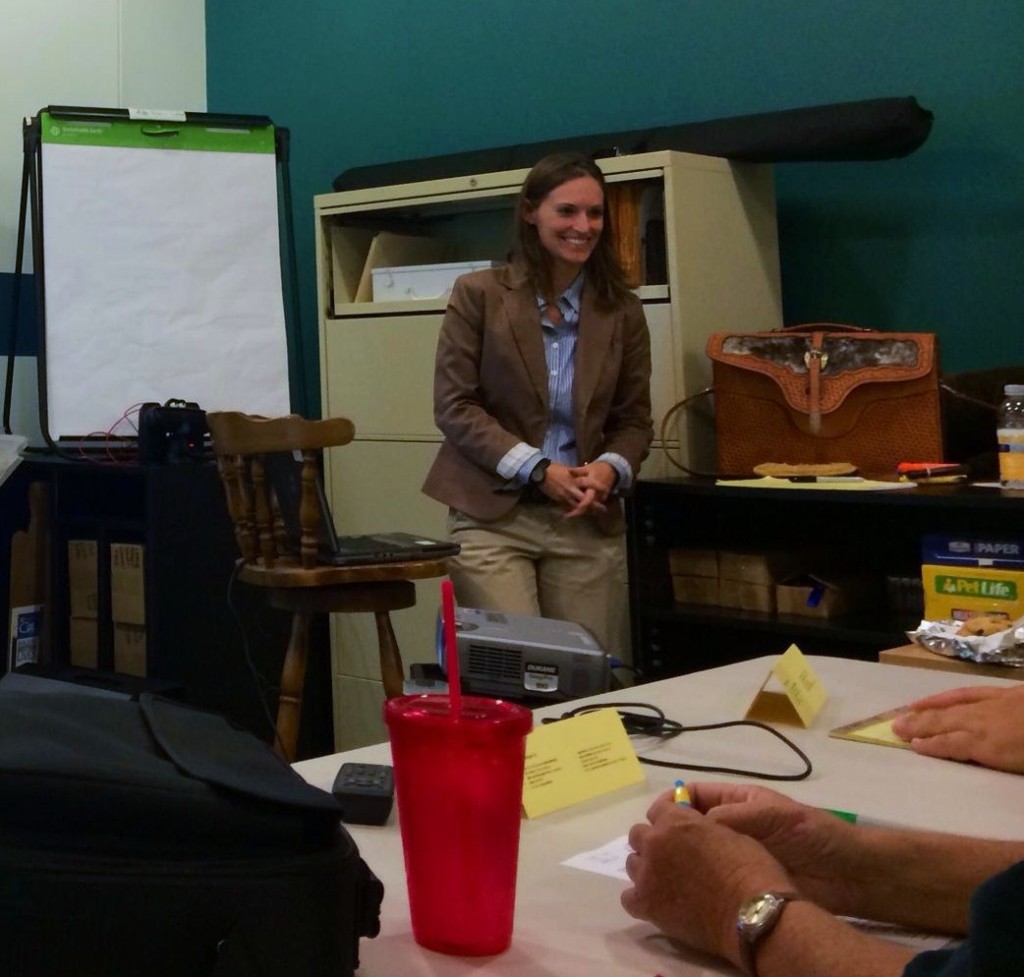
The Aiken County Animal Shelter’s (ACAS) staff and a small group of FOTAS foster volunteers are hitting the books hard after hours. During three-hour classes held twice a week at the shelter, staff members are reviewing PowerPoint slides, engaging in discussion, observing animal behavior and practicing their new knowledge through hands-on exercises with shelter dogs and cats.

It is all part of a special curriculum designed by Aiken Technical College to increase the shelter staff’s expertise and improve their job skills. Completely funded by FOTAS, the Kennel Technician class is expected to help ACAS employees become even more effective, well-rounded and flexible in their job duties.

Martha Chadwick, manager of the County Shelter, came up with the idea with Dr. Steven F. Simmons, Dean of Business, Computer Technology and Training at ATC, and Dr. Katie Comerford, DVM, is teaching the class. It is the first partnership among ATC, FOTAS and the County.

“When I approached Dr. Simmons about creating a program for Aiken County, he was genuinely interested in tailoring a specific course that would positively impact the homeless animals of Aiken County, as he and his family are also FOTAS volunteers,” Martha said.

The classes began Nov. 3 and will continue until Dec. 17. ATC supplies the instructional books and other reading materials.

The class curriculum has much of the same content as ATC’s vet assistant course but was tweaked and tailored for shelter professionals since issues and needs that come up at an animal shelter are different from those at a veterinary office or hospital.

The County Shelter’s small staff is expected to be more proficient with this new training, able to help each other with their tasks and work more as a team. For example, by learning how to properly and safely hold an animal to draw blood, insert a microchip or examine an injury or ailment, the staff can assist the vet techs if needed. Or by learning the symptoms of common medical conditions in dogs and cats, and being better able to spot signs of canine and feline illnesses, the staff can more readily alert the shelter’s vet, Dr. Lisa Levy, and her assistants to the situation so proper medical care can be administered right away.

Receiving this added education will allow the staff to cross-train for various positions and make it easier for staff members to fill in for their fellow employees if they are forced to be absent due to such unforeseen circumstances such as illness or personal emergency.

“This is a wonderful new partnership with Aiken Technical College,” said FOTAS President Jennifer Miller. “Everyone came together for this project, which will ultimately result in giving the best care possible to the orphaned dogs and cats at the shelter. This is the result of a true team effort, including the community, whose donations made this class possible.”

To learn more about FOTAS and its many activities, go to www.fotasaiken.org.

Their lives are in our hands…


The numbers don’t lie: life improves for shelter animals

By Joanna D. Samson, FOTAS Vice President

Prior to 2009, a trip to the Aiken County Animal Shelter was a death sentence for the unfortunate animals consigned to the shelter by their owners or animal control. Intake numbers often soared to 6000 or more each year, which meant that at any given time, 210 animals resided in the tiny dark and outdated shelter designed to hold 100.

The annual euthanasia rate hovered consistently around 95%.

In 2009, FOTAS was formed to provide the County with financial support and volunteers to produce a better outcome for the shelter animals. Things began to improve.

In 2009 and 2010, the euthanasia rate dropped to 89% and 85%, respectively.

In 2011 and 2012, the euthanasia rate dropped again to 75%.

Thanks to the combined commitment and efforts of the County and FOTAS, the new shelter opened its doors in early 2013. Things really improved for the County’s homeless animals.

In 2013, the euthanasia rate dropped again to 71%.

In 2014, the euthanasia rate dropped to a remarkable and record-breaking 54%.

During the first ten months of this year, 2015, the overall euthanasia rate has dropped to 40% – that’s right… 40%!! In January and August, the monthly rates dropped to an all-time low of 25%.

That’s real progress: a 95% euthanasia rate to 40% in 5 years. It is not an accident.

Modern shelter management, dedicated animal control, and FOTAS’ continued support, have made the difference.

Shelter Manager Martha Chadwick has reformed the standard operating procedures at the shelter consistent with industry standards to ensure proper, uniform and accountable care for the animals.

Shelter vet Dr. Lisa Levy has established proper medical protocol to make certain the animals are inoculated, fed, treated, spayed and neutered.

Shelter employees are cross-trained (thanks to funding from FOTAS) to maximize productivity and flexibility on the job – essential to a high-volume public shelter with limited staffing resources.

FOTAS volunteers walk and socialize the animals virtually every day, and FOTAS volunteer trainer Suzy Cohen trains volunteers and works with the animals as needed, making them more attractive adoption prospects.

FOTAS volunteers provide much needed administrative support and organize on-site and off-site events and fundraisers.

FOTAS, working with shelter staff, organized and paid incurred expenses for the transfer of 718 animals this year alone, primarily to no-kill rescue partners in the north.

Although annual intake numbers persist in the 4400-5000 range and will continue to do so until every citizen spays or neuters their pets, FOTAS has paid for the spay/neuter of more animals than any other organization in the County: 476 pets and community cats through October of this year, for a total of 1411 since 2013.

Is the shelter perfect? By no means. Can it be improved? Of course. But by every metric (except intake, which is beyond our control) the County, FOTAS and you, the supporting public, have significantly improved the condition of and the outcome for the County’s homeless animals.

Now that’s something to be thankful for this holiday week.

God Bless you and your family.

Their lives are in our hands.