



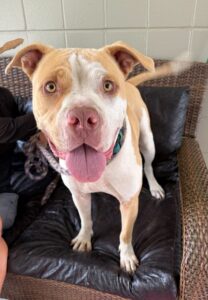
Monday mornings are noisy at the Aiken County Animal Shelter. The dogs are excited. Night is over, a new work week begins, and humans are back. It’s feeding time, and FOTAS volunteers are working quicky—dog by dog, kennel by kennel—to get them out for a quick walk to relieve themselves. It’s noisy, because as you know, excited dogs are barking dogs.
But the best part is yet to come. On Monday mornings, Hallie Glennie and Bob Gordon take up their position in the main outdoor play yard while staff and volunteers leash up dogs and line up outside the gate. Hallie signals the release of the first dog into the yard, and after a moment, once she is certain the first dog is relaxed, she signals the release of the second dog. If those two dogs are getting along, she signals the release of the third dog . . . and then the fourth, the fifth, and so on. Over the next five hours, dogs come and go out of the yard having spent their time chasing, wrestling, drooling, and jumping on and over and around their pals. SO MUCH FUN!
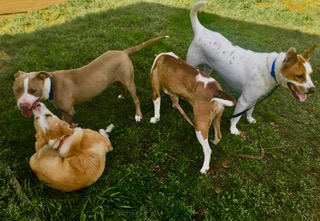
Hallie and Bob (as well as county staff Jennifer Braden, Lisa Guadet, and Cynthia Gray), who have been trained by an organization called Dogs Playing for Life, watch carefully and assess the social behavior of every dog that comes into the yard. Rough and Rowdy dogs, for example, usually dominate the largest yard, while the Gentle & Dainty dogs commune quietly in a smaller yard. Hallie and Bob look for signs of defensiveness, fear, or aggression and move the dogs in and out of the yard as necessary. If the energy gets too high in one yard, Bob might siphon a few dogs off to play in a smaller yard. If a dog looks overwhelmed by all the action, it might get moved into the pen with the Gentle/Dainties.
The goal of every play session (every morning, Monday-Saturday) is to get as many dogs as possible out of its kennel and into the yard socializing with other dogs (the team once got 57 dogs out in a single morning!). Why? Because dogs are social animals by nature, but for safety reasons, shelters are required to maintain one dog per kennel.
So, take a social animal who ends up confined to a kennel in a noisy public shelter with dogs and people who are strangers, and couple that with being abandoned by their previous owners, you get—understandably—an anxious dog. Anxious, withdrawn dogs are not adoptable dogs.
Play groups have been proven to reduce the mental and physical stress of the dogs. Play groups allow staff to make more accurate assessments of a dog’s behavior to help an adopter find the right dog for their family and lifestyle. Play groups also maximize staff and volunteer resources; they are the fastest way to attend to the largest number of dogs in the shortest amount of time.
By 1p.m., Hallie and Bob’s play session is over. For a few blessed hours, a peaceful calm falls over the shelter. The dogs go back to their kennels tired, happy, and relaxed.
That’s a beautiful thing, because a relaxed dog is an adoptable dog. Hallelujah!
Their lives are in our hands.
By Joanna D. Samson, FOTAS Vice President