

Category Archives: Foster

FOTAS: Going the extra mile

By Joanna D. Samson, FOTAS Vice President

Did you ever wonder where every homeless, injured, stray or abused animal picked up in the County (outside of the City) goes? Or where a homeless animal goes if the “no-kill” shelter is full? Or where an irresponsible County resident takes their bewildered pet when they decide that pet is inconvenient?

That would be the Aiken County Animal Shelter, which is required by law to take homeless or injured County strays, abused animals, community cats, and owner-surrendered pets. Five thousand forsaken animals a year pass through those doors, which is not only tragic, it’s costly. Caring and finding a home for all those animals is the responsibility of the County, funded by taxpayer dollars. FOTAS supplements the County’s care through private donations and volunteer effort.

Taking care of that many animals is a daunting, never-ending job for the County’s dedicated staff and FOTAS volunteers, yet every year, they manage to save more and more dogs and cats. It requires getting up close and personal with all those animals to make them appealing adoption prospects. They need to be groomed, walked and exercised. They need human attention.

FOTAS and the County go the extra mile even for the animals that seem hopeless, neglected or injured; and in virtually every case, we find a place for those animals, too.

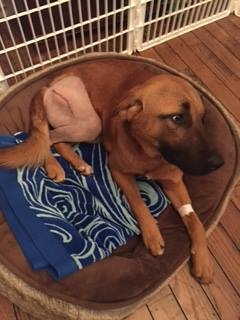
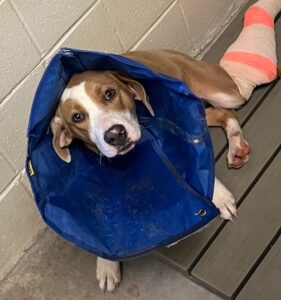
Take Henry, a handsome, one-year old shepherd mix who was picked up by Animal Control, severely injured from being hit by a car. When Dr. Levy determined Henry’s injuries needed special surgery, FOTAS recruited and paid for the services of Dr. Groover at Aiken Veterinary Clinic to repair Henry’s badly displaced hip. Today, this sweet, hopeful dog is recovering in foster care arranged by FOTAS.

Then there’s Mr. Chuck, a Corgi/Spaniel stray picked up by Animal Control. Not only is Mr. Chuck heartworm positive, but both of his eyes were badly damaged (one had to be removed by Dr. Levy). FOTAS tapped its network of supporters and made a special plea to Martha Ann Tudor in Augusta, who has a remarkable knack finding homes for hard-to-place dogs. Mr. Chuck now resides with a fabulous family on a horse farm in Aiken.

Finally, there’s Helen, a beautiful, white Lab/Bully mix that could break your heart. Animal Control found Helen abandoned, walking in circles in the middle of a country road. She had no eyes—NO EYES! (What kind of heartless fiend would do that to a dog?) Once again, FOTAS reached out to its network of rescue partners, one of whom found her a remarkable family with a special-needs child and a seeing-eye dog for Helen. Perfect.

These are just recent examples of the extra mile that FOTAS volunteers and Shelter staff go to help these unfortunate animals find the love they deserve. There is a special place in heaven for those folks.

This week, bring the joy of the season and some heavenly grace to one of the wonderful animals at the Shelter.

Like the gentle, housebroken Henry, who won’t fit in a stocking, but will gladly stay up to share some milk and cookies with Santa.

Merry Christmas and God bless.

Their lives are in our hands.
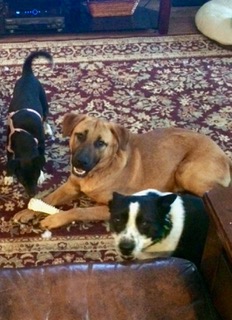
Henry and his new pals in foster care share a bone.
Henry takes it easy while he recovers from surgery.

FOTAS needs your Christmas spirit

By Joanna D. Samson, FOTAS Vice-President

“Every charitable act is a stepping stone towards heaven.”
Henry Ward Beecher

It’s the time of year when the spirit of Christmas thrives. It’s a time of gratitude for our family and friends. It’s a time to rejoice our faith. It’s a time for love.

It is also a time for charitable giving, and if your mailbox is anything like mine, it’s filled with requests from worthy local charities for year-end contributions. They all do good works, but you can’t give to them all. How do you decide?

I am going to take a leap of faith here; that if you are reading this column, you care about the plight of abused, abandoned and homeless animals. If that’s true, then FOTAS, the private partner of the Aiken County Animal Shelter, is a perfect choice for your charitable urges. Here’s why.

FOTAS provides critical assistance to more animals than any other organization in the County: 5000 Shelter animals a year.

FOTAS funded 160 kennel decks at the Shelter, the Cat Adoption Building, 2 cat condos, a grooming tub, an additional hot water heater, a surgical autoclave, supplemental medicines and supplies, and fenced play yards. FOTAS funded veterinary assistant courses for Shelter staff to increase their animal care skills. FOTAS is currently funding the addition of a medical isolation pod. If the medical needs of an adoptable animal are beyond the capacity or capability of the Shelter, FOTAS pays for outside veterinarian services.

FOTAS goes the extra mile to find every animal a home.

FOTAS aggressively markets the adoptable animals through print and social media and purchased a van to transport animals to off-site adoption events. FOTAS supplements the adoption fees for active Military Personnel and veterans and pays for heartworm medicine for HWP dogs adopted from the Shelter.

FOTAS developed a network of rescue partners in other parts of the country and organizes and pays expenses for transfers of adoptable animals. FOTAS recruits foster families (and funds their provisions, if necessary) to provide interim care for animals approved for transfer and longer-term care for animals in “a family way.”

FOTAS addresses the cause of high Shelter intake: rampant overpopulation of dogs and cats.   Since 2013, FOTAS has paid for over 2000 spay/neuter surgeries of community cats and pets owned by County citizens with financial need, and is currently developing a vigorous Trap-Neuter-Return program for free-roaming community cats.

FOTAS recruits and trains the volunteers who do much of the above.

Bottom line: FOTAS saves more animals than any other organization in the County.

Since its inception in 2009, the Shelter’s live release rate has increased from a dismal 5% to a better (but still sad), 70%. That’s literally thousands of animals.

Last month, the South Carolina Secretary of State recognized FOTAS as an “Angel” charity—one that spends 80% or more on its charitable purpose. That means you get a big bang for every buck you donate to FOTAS.

The Aiken Community has been generous to FOTAS, but there is still so much to do. Please send your much-needed donations to FOTAS, PO Box 2207, Aiken SC 29802.

Their lives, all 5000 of them this year, are in our hands

Tiffany’s story

By Joanna D. Samson, FOTAS Vice President

My early days are kind of fuzzy—some time on a chain and lots of time fending for myself, raiding trashcans and laying low. But I’m not one to dwell on the past. What’s the point?

Then these nice people took me in, fed me and tried to find me a home. When they couldn’t, they loaded me into a truck and took me to big building with lots of dogs and people called the Shelter.

“Uh oh,” I thought, “more scary humans.”

Turns out, I was wrong. Things started to look up as soon as I got there.

First, I was taken to see a smart lady in a white coat named Dr. Levy. Doc petted and fussed over me, and I didn’t mind one bit because she was so gentle. Doc was particularly worried about my eye, and to tell you the truth, I was worried about my eye, too. It had been bothering me something terrible ever since I got chased around a chicken coop by a very mad rooster and crashed into some barbed wire beating a hasty retreat. Not my highest moment, but what can I say? I was hungry.

The next thing I knew, Doc stuck me with a needle and I fell asleep right there on the table, and when I woke up, that bum eye was history. No need to fret, seriously—one good eye’s plenty for a tough gal like myself.

A couple of days later a FOTAS volunteer lathered me up with shampoo in a big tub. What a mistake that was! She scrubbed off the heavenly aroma of dead squirrel on my neck. What was she thinking? Jeez, rolling on a dead squirrel is one of the great joys of life.

But here’s the thing: after the bath, those nasty fleas were gone. Whoa! Okay, so I don’t smell so good anymore, but I’m not scratching myself to death either. I can live with that.

I have so many pals at the Shelter. FOTAS volunteers take me for walks every day. We stop at a bench in the shade for a nice belly rub and a treat. Who knew there were so many kind humans out there?

It’s a miracle: thanks to the Shelter and FOTAS, I went from being a no-name, scruffy, hungry black dog who slept in the cold and ate out of trashcans to a shiny, sleek princess named (are you ready?) Tiffany who sleeps in a warm, dry place and gets two yummy meals a day. Only in America!

Thank you shelter staff for taking care of me. Thank you FOTAS for the bath, the flea meds, the fenced-in play yards, the beds, my rubber toys and the yummy treats. And thank you FOTAS volunteers for the endless walks and all that love.

Maybe one day some kind human will take me home to a place with no chains and lots of love.

Every day this Holiday season, shocking numbers of bewildered animals are being surrendered to the Shelter by heartless owners. Help us save them—bring joy to their lives and yours: adopt a pet this month for $25 or less.

Their lives are in our hands.
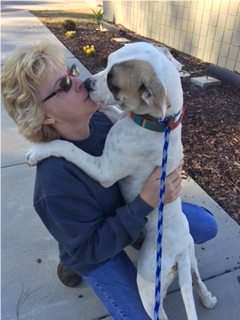
 

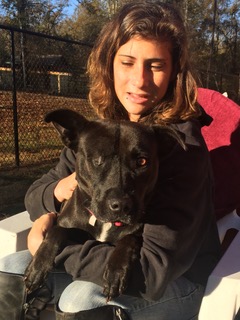
Tiffany gets some snuggle time with FOTAS Volunteer and Play Yard Supervisor, Darling Rios.

Giving Thanks

Thanksgiving is a time of reflection for those of us at FOTAS—a time to take stock of our blessings; to consider the remarkable progress we and the County have made in making the world a better place for Aiken County’s homeless, abandoned and abused animals; and in particular, to celebrate the many people who have contributed to our astonishing success and made this journey so meaningful.

Thanks to our committed partner, Aiken County, for making it possible to save the lives of thousands of homeless animals in the County. The strength of its commitment and the success of our partnership is evidenced not only by the state-of-the-art public animal shelter on Wire Road, but also by its increased commitment to subsidized spay/neuter for County residents.

Thanks to Paige Bayne, the County’s Enforcement and Animal Services Director, Bobby Arthurs, the Shelter Manager and Chief Animal Control Officer, Dr. Lisa Levy, the Shelter’s veterinarian, and all the Shelter staff for their dedication to increasing the opportunities for each adoptable animal to find a forever home and their willingness to implement new programs and practices that enhance those opportunities.

Thanks to the army of volunteers who make the work of FOTAS possible – everything from manning the front desk, walking and training dogs (91 volunteers walked dogs during the last 3 months), managing canine play groups, working special events and fundraisers, fostering dogs, organizing transfers, manning off-site adoption events, working on publicity, social media and financial record and bookkeeping responsibilities, and coordinating FOTAS-Fix-a-Pet activities.

Committed volunteers like Bonnie White, who helps at the shelter four days a week. “I get back so much more than I give,” says Bonnie. “When I leave the shelter, I’m not thinking about my bills or the dishes in the sink; I’m thinking about the dogs I helped and what else I can do to make them a better adoption prospect. Or I’m thinking about the abandoned kitten who just needs lots of love.”

Bonnie pauses. “You know what?” she says with a sigh. “I can’t adopt them all, but I sure can love them all.”

I am profoundly touched by her sentiment. I know she is not alone—all of our volunteers feel the same love, empathy, and commitment to the cause that Bonnie does.

And finally, thanks to you, the Aiken Community, for your extraordinary generosity and support. You have made it possible for FOTAS to help the County provide the best possible care for shelter animals, increase adoptions and transfers, and supplement the County’s spay/neuter financial assistance program.

And here’s the best part: all of that love, effort, commitment and hard work has paid off. The live release rate at the shelter has increased from 5% (in the pre-FOTAS years prior to 2009), to 29% (in the year before the new shelter opened in 2013) to almost 70% in the past year.

That’s a very big deal.

FOTAS and the thousands of animals that have been saved over the past 7 years thank you for your continued support. God bless you and your family during this holiday season.

Their lives are in our hands.
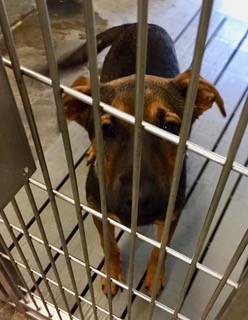
 

Bonnie White with an adoptable dog from the Aiken County Animal Shelter

Falling in love with a heartworm positive dog

By Joanna D. Samson, FOTAS Vice President

You and your family have made a decision: you are ready for a new dog, and you want to adopt your new best friend from the Aiken County Animal Shelter. You visit the Shelter and walk through the adoption pods with a staff member or a FOTAS volunteer. You meet a number of prospects, but you are drawn to a handsome, two year-old black and brown shepherd mix named Bryant who stands at attention and wags his tail when you stop at his kennel. Bryant is so openly friendly, so eager to please, you are astonished to learn that he was painfully shy and scared of people when he first came to the Shelter.

Then, as you watch Bryant attempt to crawl into the lap of Darling Rios, one of the FOTAS play yard experts, like he was a fluffy little lap dog instead of the 51-pound bruiser that he is, you think, “Wow, that’s one special dog.”

There’s only one thing: Bryant is heartworm positive (HWP). What does that mean for you, and most importantly, Bryant?

The answer is: very little, because only HWP dogs who are healthy and show no clinical signs of heartworm disease are placed on the adoption floor at the Shelter.

“Dogs are infected with heartworms by mosquitoes, but it takes a long time for heartworm larvae to mature into adult, reproducing worms that can strangle the heart,” says Jennifer Miller, President of FOTAS, “so heartworm disease in a healthy, young dog is treatable with a course of antibiotics, which weakens any maturing worms, followed by monthly heartworm prevention medicine, like Heartguard, which every dog in the South should be on anyway.”

Dr. Charles Groover from the Aiken Veterinary Clinic agrees. “I have seen and treated literally thousands of dogs with heartworm disease in Mississippi and South Carolina,” says Dr. Groover. “Here in South Carolina, I almost never see a case of heartworms that cannot be treated successfully, and in most cases, the treatment is no more expensive or time-consuming than protecting a dog who has not tested positive for heartworms.”

So, go ahead. Fall in love with Bryant or any other HWP dog on the adoption floor of the Shelter, because:

Only healthy HWP dogs with no clinical signs of disease are placed on the adoption floor;

Healthy HWP dogs, with proper treatment and care, can lead the same long, healthy lives as any other dog on the adoption floor; in fact, no one who has adopted a HWP dog from the Shelter has reported that their dog became sick or died from heartworm disease;

When you adopt a dog from the County Shelter, FOTAS pays for the antibiotics and the first 6 months of Heartguard—that’s money in your pocket because you need to give your dog the monthly heartworm prevention medicine anyway; and

Treatment is easy: after the completing the course of antibiotics, one little tasty, chewy Heartguard chunk a month is all it takes to treat and protect your dog.

Come on over to the Shelter, the very handsome Bryant is waiting to crawl into your lap and love you up.

Their lives are in our hands.
 

Darling and Bryant
Darling and Bryant

The Hurricane Season

By Joanna D. Samson, Vice President of FOTAS
By the time it hit the South Carolina Coast, Hurricane Matthew had been downgraded from a Category 5 to a Category 2 storm; but the 85 mph winds, 10-14 inches of rainfall and extraordinarily high storm surges nevertheless created life-threatening conditions and caused the wide-spread destruction of property. Thousands of people were evacuated from the coast.

But how about all the animals left behind to fend for themselves?

The Charleston Animal Society sprang into action in the week ahead of the storm, evacuating the 70 animals in its facility to make room for the anticipated deluge of animals rescued by the storm (at last count, 500). Fifty-two animals were evacuated from Dorchester County, 70 from Pawley’s Island and 60 from Horry County. Many of the animals were transferred to places as far away as Pennsylvania, Maryland, and Ohio. The York County Humane Society took in 15 cats and three dogs. Here in Aiken, the SPCA Albrecht Center for Animal Welfare took in an additional 24 dogs.

The effort and resources needed to conduct rescue operations and to handle that many additional animals are enormous: hundreds of dedicated volunteers, substantial amounts of food, thousands of extra crates, and medical supplies. Many private vehicles were pressed into service to haul the animals to safety. Already overworked shelter staff work overtime to accommodate the influx of extra animals. It’s an exhausting, time-consuming and stressful time.

Thank God those types of hurricanes only come around once every, say, 20-30 years.

But what if every week at an animal shelter was fraught with the same kind of crises, requiring the same level of resources, creating the same level of anxiety, except the cause was man-made rather than an act of God? That would be a monumental tragedy of epic proportions.

That would also be just a normal week at the Aiken County Animal Shelter during the hurricane season.

For example, take the month of August: 603 animals were taken in at the Shelter, that’s an average of 27 animals every single day. September intake was also high, ranging from a low of seven to a high of 38 (IN ONE DAY!) Twenty-one animals were taken in on September 1st, 28 on September 6th), 26 on September 12th, 27 on September 16th, 20 on September 19th, and 29 on September 22nd.

Every month in the summer, intake skyrockets, volunteers and staff are overworked and critical resources run low. It’s an exhausting, time-consuming and stressful time, but it doesn’t end once the hurricane passes.

And because the County Shelter is a public facility, it cannot turn away any animal just because there is no additional room or because resources are short.

The dedication and generosity of the rescue communities and their citizens during the Hurricane Matthew crisis was nothing short of remarkable, and I am gratified by the public response. Thank God, because there’s nothing more heart-wrenching than witnessing the suffering of animals left homeless through no fault of their own.

We know. We see it week-in and week-out, day-in and day-out, every month during the entire hurricane season. Until every County pet is fixed, your County Shelter needs your help—and not just for the occasional emergency.

Please, please, volunteer, donate, adopt. Their lives are in our hands.
 

img_2115

Why am I here? What did I do?

By Joanna D. Samson, FOTAS Vice President

Yesterday, I had a home. I had you. Today I am in a kennel in a place where there are so many other dogs. I can see dogs in the kennels across from me, but I can hear so many more. I can smell their fear and anxiety. I am afraid, too.

Why did you leave me here?

I thought we were going for a ride in the car—one of my very favorite things to do. Then we pulled in to this place, and I thought, “Oh, oh, the vet,” but I’m a brave boy, so I figured we’d see the man in the white coat, get a shot, and we’d get back in the car and go home.

But then you left me here, and you didn’t even look at me when the nice lady took me away.

Have I been bad? Is it because I barked too much when you left me outside chained to the tree? I was lonely and wanted to be with you. I just needed a little attention, that’s all.

Is it because I knocked over the garbage can? I was hungry, and there were some good smells in the can. I couldn’t help myself.

Is it because I chewed up your boot? I was bored and it smelled like you. If you had taken me for a walk or given me a chew toy, I don’t think the arm of your chair would have been so appealing.

Is it because my fur is matted and I have these ugly itchy sores on my body from fleabites? All I just needed was a bath and a flea collar.

Is it because I had that accident on the floor? I didn’t know what I did wrong because you never took the time to teach me where to go. I was terrified when you forced my face into my own mess.

Is it because I jumped on you? I was excited to see you, and I was afraid you’d go away before I got a chance to show you how much I like you.

Is it because I’m not affectionate enough? I want to be, but I’m scared when you yell at me or hit me and I don’t know why.

I wanted to be a good family member. I want to please you, but I didn’t know how. Maybe I could have learned if you had taken me to an obedience class or to one of those free lessons at the shelter.

Please don’t leave me here. I want to come home.

*****
About 2500 animals a year are surrendered to the Aiken County Animal Shelter by their owners for problems that, in most cases, could have been resolved with a little time, attention and some outside assistance.

If you are considering surrendering your pet, call the FOTAS hotline first. We may be able to help you and your pet avoid the trauma of separation.

And wouldn’t that be better for everyone?

Their lives are in our hands.
img_1738


Miles to go before we sleep

By Joanna D. Samson, V.P. of FOTAS

On Sunday morning, Sept. 2 the sun broke through the clouds, adding heat to an already steamy morning. I arrived at the Aiken County Animal Shelter to help walk dogs, and I was delighted to see so many volunteers at work. There were dogs on leashes, dogs in the play yards, and dogs lying in the grass, soaking up the sun while their handlers chat. A young couple laughs while they take out their fifth dog. Enduring friendships are forged when folks come together for a common purpose.

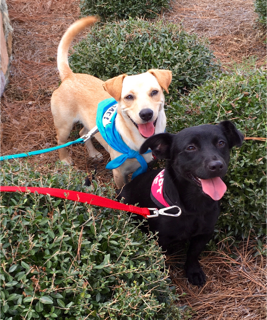
I leashed up Jed and Geovana. These two young littermates were picked up as strays, painfully thin, hungry, thirsty, hot and frightened. Little Jed had an embedded collar around his neck that had to be surgically removed by Dr. Levy, the Shelter’s veterinarian. The two are recovering nicely. Geovana is shy, a little distrustful of humans, but who can blame her? Jed, on the other hand, is all play with a devilish twinkle in his eye.

I stopped at the bench behind the paddocks. With a little coaxing, Geovana crawled into my lap for a belly rub, while Jed wrestled with a pine cone on the ground.

The Shelter is a cheerful place. There are grassy play yards, dotted with cheerful umbrellas to provide shade for animals and people. The kennels are spacious and clean, allowing the dogs to either bask in the morning sun or retreat into the cool climate-controlled interior.

Thanks to the thoughtful and creative management of Bobby Arthurs and the oversight of Paige Bayne, the Shelter is once again open for adoptions on Saturday; volunteers are permitted to walk the dogs on Sundays; new programs, like the play groups for dogs, have been implemented to promote the quality of life, and thus the adoptability, of the dogs. On-site activities draw more people to the Shelter every week. There is a heightened, almost seamless, sense of shared mission and cooperation between staff and volunteers.

Adoptions are up.

Transfers are up, thanks to the tireless and exhausting efforts of FOTAS.

Yet despite all of our proactive efforts to care for these animals and to support the spay/neuter of community cats and pets for citizens in need (no one dedicates more resources to spay/neuter than FOTAS and the County combined), intake at the Shelter remains alarmingly, shockingly high.

And it will remain that way as long as people continue to do things like drop off 3 mommas and 18 puppies in one tub (yes, that happened!) The owner couldn’t be bothered to spay his dogs, and then couldn’t be bothered to take care of those 18 little lives born because of his irresponsible carelessness.

Instead, he dumped the cost and the heartbreak of that on the rest of us.

Here are the cold, hard facts: until every citizen does the right thing and fixes their pet, some adoptable pets will be at risk for euthanasia. That stinks.

Geovana licks my hand. Jed pounces on my shoe. “You two will be just fine,” I say, giving them both a hug. “I promise.”

It’s a promise I know we can keep for now.

Their lives are in our hands.
 

pastedgraphic-1

Want a longer, happier life? Adopt a shelter animal in need

By Bob Gordon, FOTAS Director of Communications

If you needed another reason to go to the Aiken County Animal Shelter and adopt a homeless pet in need, here’s a big one: having a dog or cat at your home can help you live a longer, happier life.

Research shows that living with pets helps lower blood pressure and reduces anxiety. Pets also boost our immune systems, which helps ward off disease. In 1987, the National Institutes of Health (NIH) stated that “pet ownership is a variable in public health outcomes that, like food and exercise, cannot be ignored.”

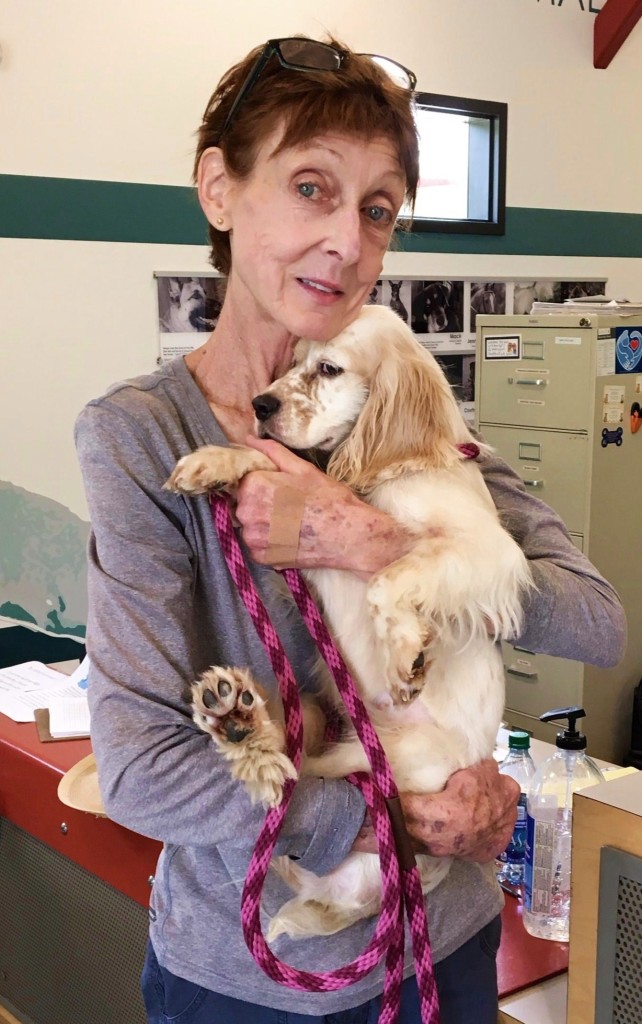
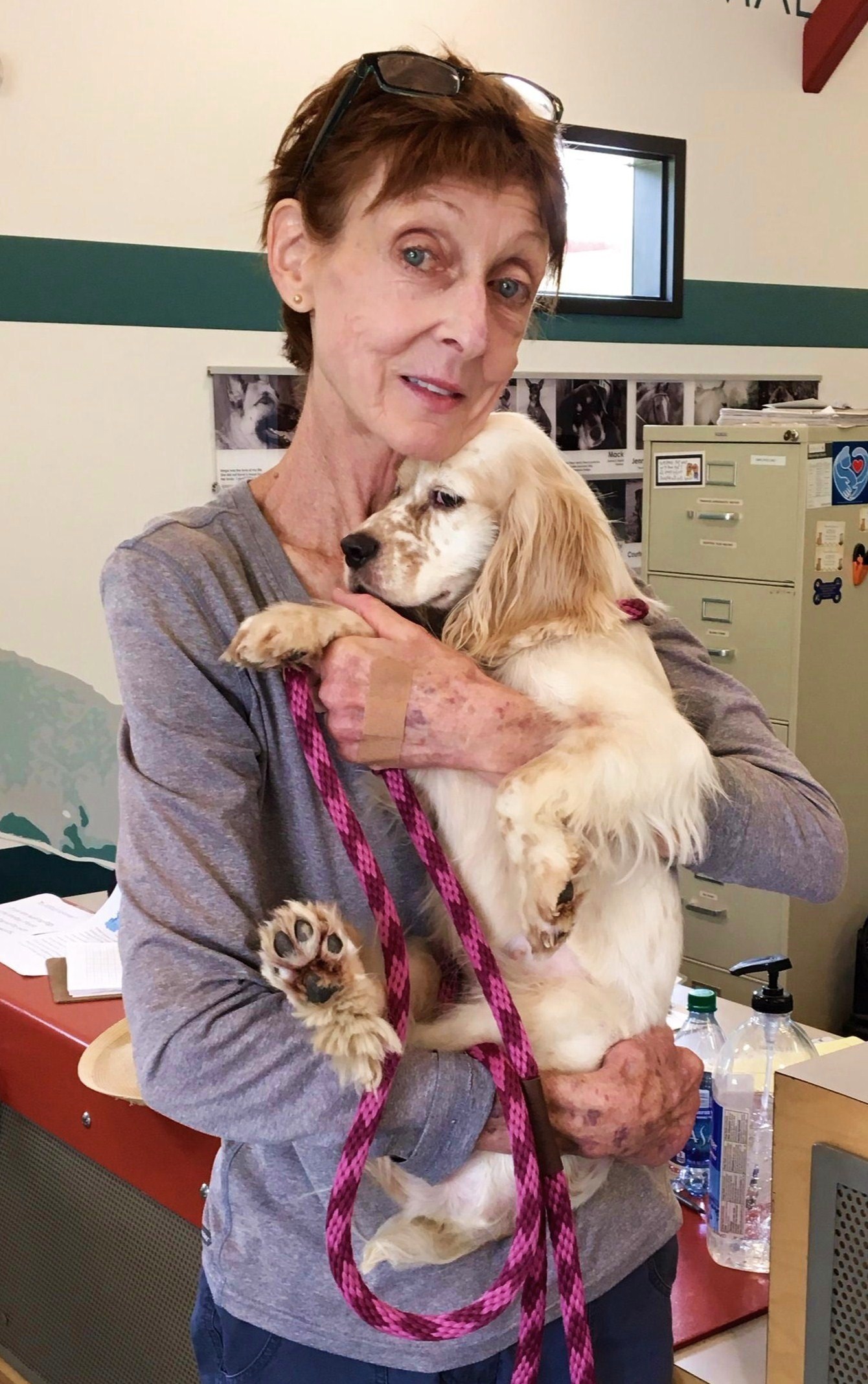
“Life is hard and having a pet softens the edges of it,” said Sue Ellen Benson, a Windsor resident and FOTAS volunteer, who recently adopted a sweet, seven-year-old Cocker Spaniel named Bonnie. “Pets make life easier because when you are focusing your attention on them, whatever problems you might be dealing with fade into the background.”

In the last three decades, the advantages pets can provide have become even clearer. Dogs, which have long been used to aid the blind, are now used to help people who have mobility and balance impairments. Also, since dogs can be so sensitive to human emotional needs, they are often used as “therapy pets” to help individuals suffering from PTSD and other anxiety-related conditions. These canines can provide a constant calming effect and the emotional support needed by people coping with such issues. FOTAS has helped select such dogs for veterans returning from overseas as well as for children coping with severe autism.

Cats also provide health benefits to their owners. Owning any pet is good for your heart but cats in particular lower your stress level. Petting a cat has a positive, calming effect as does hearing them purr. In fact, a University of Minnesota study found that over a 10-year period, cat owners were 30 percent less likely to die of a heart attack or stroke than non-cat owners

“We totally believe in the health benefits of pets,” said Kristin Chandler, who adopted two kittens, Olive and Tolliver, from the County Shelter this summer. She and her partner, Faith, are FOTAS Volunteers and also have three dogs living with them in their North Augusta home. “From exercise to stress relief, we wouldn’t know what to do without our animals,” Kristin added. “They know a lot more and pick up on more things than we give them credit for.”
If you are looking for a pet to make your life better, now is a great time to adopt from the shelter. The shelter is full and needs people to give these wonderful animals forever homes. There is a wide selection of dogs, cats, puppies and kittens to choose from and some of the animals are on special this month. FOTAS and the shelter are participating in Best Friends Animal Society’s national adoption promotion, “Welcome Home Your New MVP”, so cats and kittens can be adopted for just $15 and all Bully mix dogs are available for half price ($35). 

To see the animals available for adoption, please visit the shelter. You can also go to fotasaiken.org to see photos and short profiles of adoptable dogs and cats online.
Their lives are in our hands…


Sue Ellen Benson with her adopted dog Bonnie august 2016
FOTAS Volunteer Sue Ellen Benson says adopting Bonnie from the shelter changed her life for the better.
Kristin with Tolliver for FOTAS column
Kristin Chandler says she wouldn’t know what to do without her adopted animals, including Tolliver, a cuddle-loving kitten.

Lost, mud-covered pup leads family to love Bully mix breeds

By Bob Gordon, FOTAS Director of Communications

Five years ago, Lauren Kilbreth was heading home after a job interview when she passed some little kids running from a mud-covered puppy. Lauren wasn’t in the best part of town, it was cold and pouring rain, and she was dressed in one of her best business suits – but she felt compelled to turn the car around and head back to investigate.

“He looked lost and I was worried he might get hit by a passing vehicle, so I decided I would get out of my car and call him to me, and if he ignored me or became aggressive, I’d just continue on my way,” Lauren says.

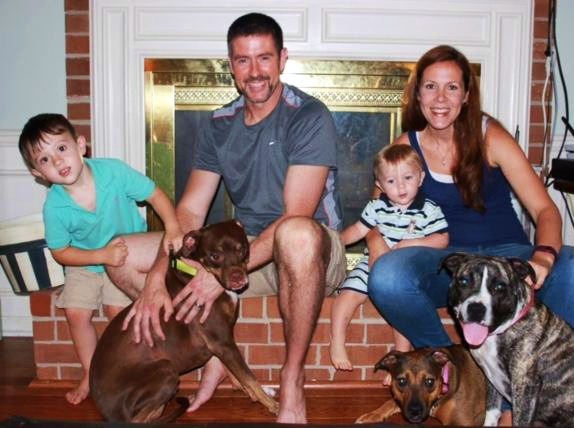
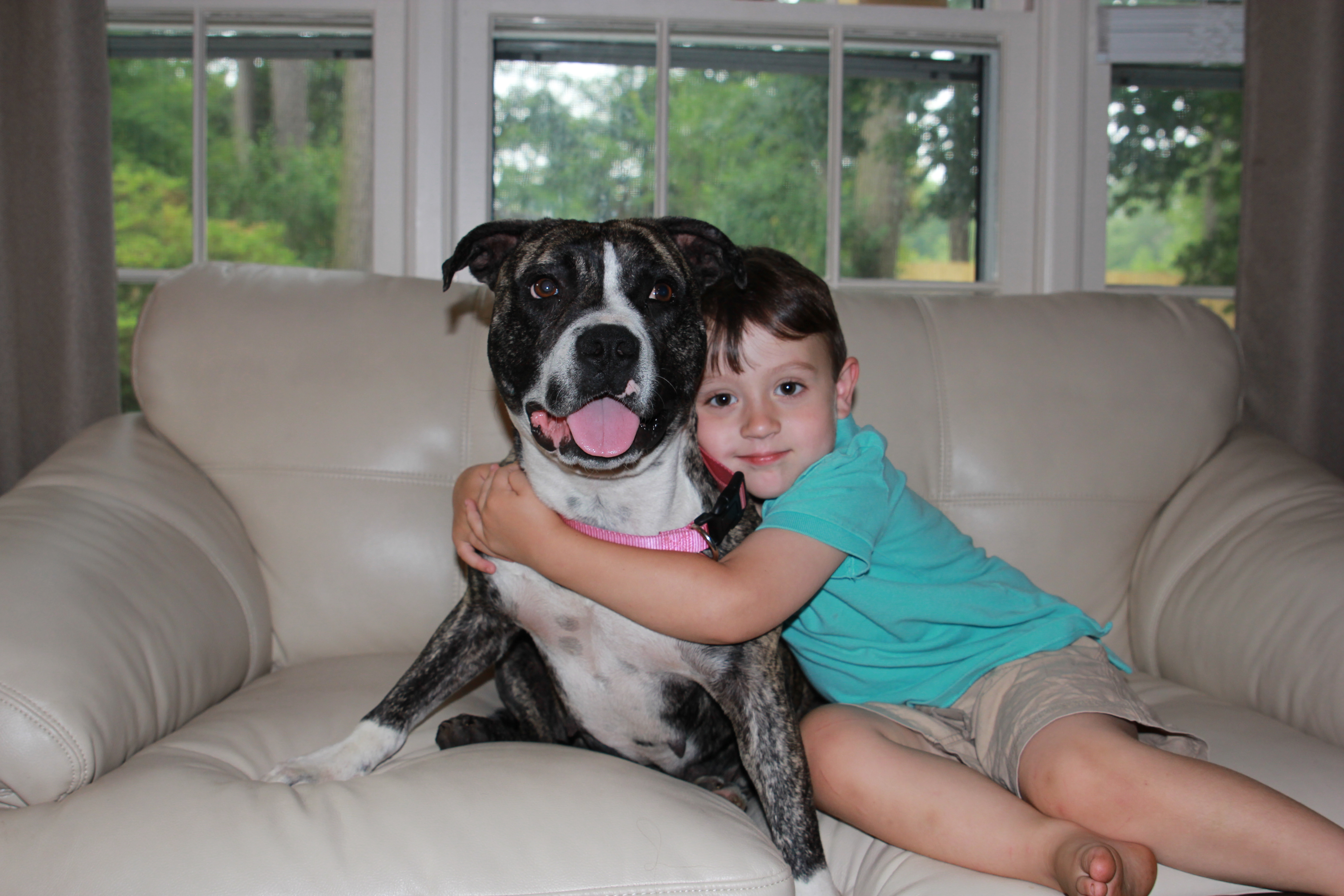
But when she clapped her hands once, knelt down and called out to the pup, he came running into her arms. Lauren took him home, gave him a bath and she and her husband, Ryan, became smitten with the brown Pit Bull mix pup with a white chest. Not only was he a loyal love bug to the couple but he also got along well with their two older Greyhounds, Grace and Baxter, and Stella, their Westie. The Kilbreths named their new, furry family member, Rock.

Rock grew to weigh 60 pounds and became the alpha dog. When Lauren and Ryan had their first baby, Easton James, Rock showed extraordinary interest, always watching over the child and needing to look over Lauren’s shoulder when she changed the baby’s diaper. Rock nurtured their second baby, Deacon Reid, the same way.

Friends who visited the Kilbreths were initially a bit wary of Rock. They weren’t sure how they felt about Bully mix dogs because of the negative way they are portrayed in the media. But most came to love Rock. Some even got Bully mix dogs of their own.

All was great at the Kilbreth home until last year, when their two oldest dogs, Grace and Stella, were diagnosed with cancer and rapidly succumbed to the disease. Baxter handled their deaths well but Rock became depressed and withdrawn. Lauren, now a volunteer at the Aiken County Animal Shelter (ACAS), decided it was time to find a new playmate for Rock. She took him to the Shelter to meet her favorite prospects and he picked a lovely, one-year-old Bully mix named Evie May, who quickly made Rock a happy dog again. Then, just three months ago, the Kilbreths adopted another young Bully mix beauty from the shelter. At 75 pounds, Ava Rae became the biggest dog in the Kilbreth home and has fit in beautifully with the other canine family members. She is heartworm positive but the slow-kill treatment for her condition, paid for by FOTAS, is nearly complete.

The ACAS currently has a number of Bully mix canines available, including seven dogs and four puppies. Carson, Cy, Conor, Chip, Delta, Connor and Tavis are the adults and the two-month-old pups are Claressa, Jeremy, Klay and Shadrack.

“Take a chance on these dogs,” Lauren says. “They are extremely loyal and have a lot of love to give. Never judge a book by its cover. Go to the shelter and see for yourself how sweet they can be.”

Their lives are in our hands…

KilbrethFamily1

KilbrethFamily4

KilbrethFamily3